Showing posts with label 3rd Grade. Show all posts

Sunday, August 9, 2015

Your Job Is To Protect the Students

I was scrolling through my Facebook newsfeed when I came across this status from Jon Acuff.

Yesterday on my flight, a 13 year old boy who was traveling alone sat next to me. Before we took off he lowered the tray table in front of him, put his head in his arms and started sobbing. Big tears covered the tray as he wept in his seat.

I asked him, "Are you alright buddy?" He told me he had spent 3 months with his mother for the summer and was flying back to another state to live with his dad.

Sometimes the frequency of divorce makes us forget the heartache of it. It's such an ordinary thing these days that we tend to rush right by the extraordinary pain it causes.

As an adult, I have had friends that have dealt with divorce. Sadly, it seems like an almost daily occurrence when my wife tells me that a friend of hers is going through a divorce. It is heartbreaking to know that a relationship that was supposed to last forever is coming to an end.

The even sadder reality is that this is an all-too-common occurrence in our classrooms. There are children who deal with the heartbreak and devastation of a divorce on a daily basis. Sometimes, Mom and Dad get along great after the divorce and sometimes it is nasty between them. Regardless, there is pain for the children. I am thankful that my parents are still together. It was a bit dicey at times, but they are still together.

We think we were hired to teach children and that is true. More importantly, we were hired to protect the students, to keep them safe, and to help them understand the world around them. It is pretty scary being an adult; it is even scarier being a kid. Love your students, make sure they know you are a safe harbor in their chaotic world, and teach them to love and protect each other. That is your job, the most important job you have when you enter the school building each day.

Your job is protect to the students.

Wednesday, July 1, 2015

Currently for the Month of July

It's summer, so my blog will be temporarily resuscitated (well, I hope so anyway). To kick things off, I am participating in the July Currently (hosted by Oh' Boy 4th Grade).

Listening - I am currently listening to the Jimmy Buffett station on Pandora. I am by no means a Parrothead, but Mr. Buffett's music has a very special place in my heart. My wife and I (back before we had 5 kids) had the privilege of traveling to Las Vegas on our honeymoon and to Orlando to celebrate a few of our anniversaries. At each of those places, we ate dinner at Margaritaville. It was a fantastic time and a great place to eat. So listening to Jimmy Buffett, Zac Brown, etc. reminds us of those trips. Needless to say, this station is on quite a bit.

Loving - Summer school started today! I know a lot of teachers really look forward to having summer vacation so they can relax at home, but I love teaching and I love being with students. Our county offers summer school most summers and I have taught in many of the sessions. This year I am in my own building, in my own classroom, so it feels awesome. I am looking forward to a great couple of weeks. Plus, as I mentioned, my wife and I have 5 kids, so the extra money goes a long way to help pay for new school clothes, shoes, and school supplies.

Thinking - I am thinking that I need to get started on my summer projects. I really want to make some new bow ties. I have two Teachers Pay Teachers activities that I need to make (fractions on a number line using mixed numbers and a set of graphing task cards for picture graphs). And, most importantly, I need to start making the videos for my flipped classroom idea. I have about 7 weeks, so I need to get cracking!

Wanting - I really want a MacBook Pro. I mean, I really want a MacBook Pro. There are so many cool features and apps on a MacBook that just aren't available on my current PC. I listened to a podcast on making iBooks. I need to make iBooks. I watched a video on using iMovie. I need to make movies on iMovie. One of my favorite YouTube channels is called Film Riot and they use a program called Final Cut. I need to use Final Cut. However...a MacBook Pro costs about $1,000, give or take. That is definitely not in the budget. My wife needs a new laptop and we need to replace the tile flooring in our kitchen. So, yeah, I guess I need to keep wanting. That is unless someone wants to bestow a wonderful gift upon me. (Either that or visit my Teachers Pay Teachers store and check out the awesome math products I have available.)

Needing - I need to get some motivation. We just got back from vacation last week. It was an awesome time, but I haven't really accomplished anything since we got home. It didn't help that it took nearly two hours to get home today because of all of the road construction, but I still need to get my butt in gear if I am going to accomplish all of the things I listed above.

All Star - I love the fact that my fellow teachers come to me to ask tech advice. I really love technology and look for ways to add technology to my lessons and teaching. I'm not the most technical person, but I do enjoy looking for new ideas and coming up with ways to make my lessons more engaging by implementing technology into them. I also love sharing those ideas and techniques with others. Our Technology Resource Teacher decided to pursue another adventure at the end of this school year. There were a lot of teachers who approached me to pursue the job. Sadly, I don't have a degree in technology or I might have considered it.

So that is where I'm at on this, the first day of July. Tomorrow is my wife's birthday and July 4 is my son's birthday. July 31 is our 11th anniversary. Life is good. And, to show you how good life is, I will leave you with some pictures from our vacation.

Friday, March 20, 2015

Three Things I Try to Tell My Students Every Day

 photo Three Things I Tell My Students.jpg

For anyone who is a teacher, you know that it is game on from the moment the bell rings in the morning until the last student gets on the bus at the end of the day. It is crazy and hectic and there are days I forget that I need to drink water and go to the bathroom. I forget to sign papers and one time I even forgot to send home report cards. Trust me, the parents and students didn't let me forget the next day. I think I am still answering emails about that.

However, even with all of the craziness that is a day in a third grade classroom, there are three things I try to tell my students every day. I can't say that it happens 100% of the time, but I do make an effort to let them know these things every day.

  1. "You are doing a great job!" I want my students to know that I think they are doing a great job and that the work they are doing is being noticed. I want my students to work hard and I want them to be recognized for that fact. I tell them this even if they have only completed half of the activity because, for some students, they are working to the best of their abilities. Sometimes, as teachers, we tend to focus on the students who complete all the work and answer all the questions. I'm guilty of that very thing. I want to make sure that my students know that I see what they are doing and I think it is great.
  2. "I'm proud of you!" I tell my students I am proud of them all the time. When a student completes a multiplication problem he has struggled with for several minutes, I let him know how I feel. When a student has had a bad day and does something remarkable, I let her know how I feel.
  3. "I love you." The first time I told my students I loved them, most of them gave me strange looks. "Did our boy teacher really just say that?" I tell my students I love them every day. Sometimes it is "I love you very much, but you all are driving me crazy at the moment," but I want them to know how special they are to me. I know it is cliche, but I may be the only one who tells them "I love you" in any given day. I pray that this isn't the case, but it might be. I say "I love you" to my class so often that, as I was leaving the other day for an appointment, as I walked out the door, one of the girls called out, "Mr. Pearson, aren't you forgetting to tell us something?"

Why do I do say these things? Well, there are lots of reasons, but, mostly, I want to build relationships with my students. I want them to know I care about them and they are more important to me than tests scores and reading data graphs. I want them to trust me and to know that I am there to protect them, even on those occasions when I am upset with them because of their behavior. It makes it so much easier and more effective when I tell a student, "Hey, you are out of control and you need to settle down," if they know it is coming from a person who loves them and wants the best for them.

Do you say these things to your students? What are some things you tell your students every day? Please share in the Comments!

Friday, March 6, 2015

Making and Using Videos in My Classroom

The other day I had a scheduled day off. It wasn't necessarily a fun day, but I had to be at the Admin Building for some training for committee that I help facilitate at our school. On the day I was to be off, my students were going to begin learning (and/or reviewing) how to tell time on a clock to the nearest minute.

As a literature tie-in to the lesson, I decided to read Game Time by Stuart Murphy. This is a great book that talks about units of time and how they work on a clock, all set in the context of students playing a soccer game. I knew my students were going to love it.

The only problem was that I wasn't going to be there to read it to them. Obviously, I could leave the book for the substitute to read, but I didn't want to for some reason. So, I decided to make a video of my reading the book. It's not a particularly well-polished video, but it achieved the purposed.

If you are interested in the video, I posted it below.

The best of part of this story is this: When I returned to school the next day, I asked my students what they thought about the video. I figured they would say they liked it, but one student had a really great answer. She said, "I liked the video because it's like you are here with us, Mr. Pearson, even when you aren't in the classroom. We miss you when you aren't here. Well, at least I miss you."

So, yeah, that's why I make videos, even if they aren't always the best.

To subscribe to my YouTube channel, please follow this link to get signed up.

Do you make videos for your classroom? How do you use them?

Thursday, September 18, 2014

I Love My Job

I am experiencing a new adventure this year. I am co-teaching a third grade class that has an enormous number of students who have been identified for special education services. Yeah, it is exactly how it sounds.

Yesterday, in class, one of my students put his arm behind his head, pulled his sleeve up, and began sniffing and (possibly) licking his armpit. I was trying to teach about rounding numbers to the 1,000s place. Do you have any idea how hard it is to teach on rounding when there is a student licking his own armpit?

I have another student who became very upset at transition time. He was standing in the room, sobbing. The reason he was so upset was because he had a handful of rocks wrapped up in a paper towel. Every time he would try to pick up his book box to leave the room, he would drop some of his rocks. "How can I carry my cubby when my hands are full of rocks? I can't pick up my cubby because I have to hold on to these rocks! I'm not going to be able to leave school!"

Another student was singing "What You Gonna Do With That Big Fat Butt?" in the lunch room. My student with autism told on him and he started to cry.

There is a little boy in my class who can only read 6 words per minute. He stumbles over the simplest sight words. When he was given a reading passage as a part of his PALS testing, he looked at the passage (with the very large print and few words on the page) and said to the teacher, "Are you kidding me? This is a joke, right?" I gave him a story that I wrote using some site word phrases and his response was, "I'll read this, but your story doesn't make any sense."

I also have a student who is extremely sensitive to noise. I gave her a set of headphones to wear because I thought it might cut down on the amount of noise she can hear. Unfortunately, I have created a monster. Now, she wants to wear the headphones all the time and the headphones have to be "plugged in." Oh, and now all the other students want to wear headphones as well. It is like a Daft Punk concert in our hallway.

I love my job.

Wednesday, July 30, 2014

Guided Math In Action Book Study - Chapter 7

 photo e9efbcd9-76a6-4ffd-acc8-6a116ff8c7d0.png

Chapter 7 of Guided Math in Action looks at the opportunities teachers have to build mathematical proficiency while having small groups. The chapter is broken down into five sections. These include:

  • Conceptual understanding
  • Procedural fluency
  • Strategic competence
  • Adaptive reasoning
  • Mathematical disposition

Let's examine each one briefly.

Conceptual Understanding. Conceptual understanding is when students know what they are doing on a conceptual level. This is often what we teach in our small groups. Dr. Newton give the example of using coins to help teach dividing decimals. There is also a sample lesson that shows how one teacher used this strategy, giving students 28 pennies and asking them to put the pennies into 4 groups. This portion is where manipulatives and the teacher toolkit comes into play.

Procedural Fluency. Procedural fluency is knowing how to do mathematical procedures. It is when the students know how to do math. The example that is given in the text is adding numbers with 8 (a concept that I am totally going to "steal"). Students know the procedure of adding 2 to a number that ends in 8 to help make the number friendlier.

Strategic Competence. Strategic competence is when students are able to solve a problem and then explain their thinking as to how they were able to solve that problem. Students don't just jump straight for the answer, but they can show someone what they did to solve that particular problem. This can include using number lines, grids, or arrays. It is important for students to have a number of different ways to solve a problem.

Adaptive Reasoning. Adaptive reasoning is when students can think logically about math and then explain and justify why they chose that specific course of action. These mathematical discussions should allow the students to talk in an environment where they know their thoughts have value and they will not be made fun of because of the way they did a problem.

Mathematical Disposition. This area focuses on what students believe about math. How many students do you have that believe they are bad at math? As teachers, we need to promote perseverance, so that students will understand that some problems just take longer to solve. This involves scaffolding and helping student to stick with a problem or concept. Reflection is also a big part of this area.

 photo 27d7aebb-ed41-4507-86ad-03726ff0bfdb.png

I am only going to focus on answering the second question today. In my math classroom, we focus a lot on problem-solving. One of the key aspects is what we call the "Wrap Up." The Wrap Up is a concluding question (based on the day's lesson) in which students are asked to explain their thinking about a particular question. They are given the opportunity to solve the problem using words, numbers, or pictures. At the beginning of the year, the vast majority of the students will write one or two words. As the year progresses and the students become more adept at answering and solving math problems, their thinking becomes more elaborate and I begin to see longer explanations and pictures to illustrate their thinking. Of course, this type of thinking requires a good deal of scaffolding. Many third grade students try to take the easy way out when it comes to math, so building their perseverance is a huge part of teaching.

Be sure to join us on Sunday for Chapter 8.

Tuesday, July 29, 2014

Two for Tuesday - Great Place Value Activities 50% Off Until Friday

It's Tuesday, so that means it must be time for another...

Two for Tuesday

 photo 86029bf5-9d53-4f53-bd8a-c0e188cafb63.png

To celebrate the fact that it's Tuesday (and school is about to start for most of us...sad but true), I've put two of my place value activities on sale for 50% off until Friday, August 1! Just click on any of the pictures below to go to my Teachers Pay Teachers store to take advantage of these great offers.

Place Value Scavenger Hunt

The first activity I have listed is the Place Value Scavenger Hunt. My students loved Scavenger Hunts! This particular activity had 28 questions that were related to place value concepts. The students were asked to round numbers, compare numbers, and write the numbers in different formats (standard, written, and expanded form). Each of the cards has a unique QR code associated with it.

The Place Value Scavenger Hunt makes a great center. I prepare the cards on cardstock and laminate them for durability. Then I cut out the cards and hang them randomly around the classroom. The students use the included recording sheet to write their answers down. After completing the activity, the students would use the classroom iPad to scan the QR codes using an app installed on the iPad. The QR code would provide the students with the correct answer, making the activity self-checking. Of course, the Scavenger Hunt can be used without an iPad as well.

This product normally sells for $3.50, but you can purchase it through Friday for just $1.75.

Check Writing - A Place Value Activity

The second activity is Check Writing - A Place Value Number Writing Activity. This activity is designed to student to the real world concept of check writing. The students are given the option of choosing from 24 different task cards and they are also given a blank check. The students are to fill out the check with the information on the card.

This was one of my students' favorite activities during our place value unit. They felt so grown up writing checks to me, their parents, and to the principal. One student even asked if she could take her checks to the principal. Too bad the checks weren't real.

Check Writing normally sells for $3.00, but, until Friday, it is on sale for $1.50. Please don't miss out and definitely share this with your friends and fellow teachers.

These are great activities to start the school year with, especially if your first unit is place value. You can also visit my Teachers Pay Teachers store for other great math activities. You can also follow my store to get updates when new products are available.

Tuesday, July 22, 2014

Two for Tuesday - Save 50% Through Friday

Today, I'm going to do something different. I'm going to offer two of my best-selling products from my Teachers Pay Teachers store at 50% of the regular price. I don't usually sell my products here on my blog (at least not this blatantly), so that's why it is different. So, I am linking up with the wonderful ladies of The Teaching Tribune for Two for Tuesday.

 photo 86029bf5-9d53-4f53-bd8a-c0e188cafb63.png

Subtraction Across Zeroes Task Cards

The first product is a set of task cards to help students practice subtracting across zeroes. A number of my students had difficulty with this particular topic, so I wanted to make something for them so that they could have extra practice during centers. It turned out that this product struck a nerve with others and it has sold more than any other product in my store. I recently updated the product and added several other items to it. Subtraction Across Zeroes sells for $4.00, but through Friday, July 25, it is on sale for 50%.

Identifying Fractions on a Number Line

The other product that is on sale is Identifying Fractions on a Number Line. To be honest, I was pleasantly surprised that this activity has been so popular. This is a set of 32 task cards that ask students to identify a fraction based on where the X is on the number line. It can be challenging because students have to determine how many sections the line has been divided into (the denominator) and find the position of the X (the numerator). This set of cards (like all of my task cards) are perfect for play Scoot, scavenger hunts, math centers, or for use in small groups. Identifying Fractions on a Number Line is normally $3.00, but is marked down to $1.50 until Friday.

I know that most of us still have a couple of weeks before school starts, but it is never too early to start planning ahead, especially when you can get an awesome deal like this. Hurry, these special prices are only available until Friday, July 25. And, while you are looking for great deals, be sure to head over to The Teaching Tribune to see other great offers.

Thursday, July 17, 2014

How I Became a Teacher - My Journey to 3rd Grade

 photo HowIBecameaTeacher.jpg

It was never my intention to become a teacher. I never had any grand aspirations of "shaping the world of tomorrow" or "trying to make a difference" or any of that type of thing. In fact, I didn't even go to college with the intent of studying education. I went to college to study to become a pastor.

I attended Pensacola Christian College to study Pastoral Ministries. This is a great school if you are interested in studying the Bible. It is, however, not a school for everyone, but that has nothing to do with this story. After a semester or so, I quickly realized that, even though I still wanted to be a pastor, Pastoral Ministries was not for me. I didn't "fit in" with that crowd and so I needed to change my major. So, I decided to study to be a lawyer. From one side of the spectrum to the other, right?

When I spoke to my academic advisor about the major change, she suggested that I consider pursue something like history or English instead of pre-law. The reason was that, if studying law didn't work out, I would have something else to fall back on. With this thought in mind, I decided to change my major to Elementary Education. This would allow me to study a wider variety of subjects (math, science, history, English) instead of just focusing on one main area. Plus, there was about a 99:1 ratio of females to males in the Elementary Education department. In many of my classes, I was the only guy. Unfortunately, many of them were friends with the girl I was dating at the time, so...moving on.

While I was studying and practice-teaching, I was still preparing and desiring to become a pastor, more specifically a youth pastor. Turns out I was pretty good at being a teacher. Obviously I was a little rough around the edges and not what my professors would call a "star pupil," but I did pretty well. I completed my student teaching, graduated, and moved back home. I was volunteering at my church as the lead youth worker and I got a job at Faith Christian School as a 4th grade teacher. That was my introduction to full time education. That first year was incredible. I had a wonderful class of students. It was a small school, so I had a small class and I team-taught with a wonderful teacher, doing what I do today: math and science. During this year, I also got engaged to the girl who is now my wife (we've been married for 10 years!).

After getting engaged, I realized that I needed to make a little bit (by a little, I actually mean a lot) more money, so I began looking into working for the public school system in my county. I had a few connections from a summer job I had had in the personnel department and that helped me to get an interview. I interviewed and that fall I began my career as an elementary school teacher. I have been in the county for ten years at this point.

My teaching career has had some ups and some downs. I was still interested in becoming a youth pastor and even served as one part-time for nearly a year. I honestly believed that I was going to leave education and become a youth pastor full-time. It would appear that God had other plans for me. I am no longer in that ministry and have found a deeper love for my job as a third grade teacher. Part of that comes from my work with Teachers Pay Teachers. It is always interesting how people end up doing what they do.

My journey to becoming a teacher began with a desire to become a pastor. Through several twists and turns, I cannot imagine doing anything other than being a teacher. I have been blessed with an awesome team and great students and the county I work for takes very good care of me. I am truly blessed.

How did you become a teacher? Leave a comment and share your story.

Saturday, July 5, 2014

My Favorite Parent Comments

Wonka photo 52093003.jpg

Over at Buzzfeed.com, there is a list called "21 Things Parents Say That Drive Teachers CRAZY." As I was reading through them, I was amazed at how many of them were incredibly true. It was like they had a microphone and camera in my classroom.

In honor of this list, here are a few of my favorites.

  • My child would never, ever act that way! Sadly, I hear this one a lot, especially from the parents of the students who actually do act that way...all the time! I sometimes want to say, "Ma'am, if I am calling you, it is either really bad or this is the seventeenth time this week your child has done this very thing." I guess we all see our children through rose-colored glasses.
  • How could my child possibly fail his math/spelling/science test? Unfortunately, this statement is repeated way too often. Of course, the lack of preparation for the test may have something to do with the doubleheader he played in or the 3-hour dance rehearsal. As a teacher, I know I do my best to prepare my students for the upcoming assessments, but nothing can take the place of reviewing the material at home the night before the test.
  • Did you get my email? I receive many, many emails per day. Because I work for a large county, every online university in the nation wants me to enroll to receive my masters degree from them. Sometimes they want me to enroll so badly, they send me two or three invitations...within minutes of each other. I say this to say that sometimes emails get shuffled around. Sometimes email has to wait until the end of the day or the next morning. I appreciate that email is an excellent communication tool, but sending reminder emails about the first email is often not helpful. It just pushes the first email that much further down the list. This is why I remind parents that there is a 24-hour response time on emails and emergency matters should not be communicated this way.

I hope that this post doesn't come across mean-spirited. I have been blessed over my teaching career with some really incredible parents to partner with. Teaching is a challenging job. Parenting is a challenging job. Together, we can make it that much more rewarding for everyone.

Sunday, June 29, 2014

Help Me Celebrate With a Friend!


A friend, Tabitha from Totally Sweet Math Centers by Tabitha, recently hit a huge milestone over at her Teachers Pay Teachers store...1,000 followers! I think this is huge because, after almost a year on TpT, I just recently hit 121 followers. So to me, 1,000 is massive. Anyway, to help Tabitha celebrate, I am participating in a really big giveaway. All of the details of the giveaway are below, but make sure you are seated because it is mind-blowing.
I've teamed up with the best of the best TpT sellers for what I'm sure will be an amazing giveaway! 10 winners will each win one of the prize packages listed below. Each package contains a $10 shopping spree to 10 different stores- that a $100 shopping spree and a total of $1000 in products in all!


You can enter right from my page. Best of luck! 


a Rafflecopter giveaway

Thursday, June 26, 2014

Three Resources I'm Excited About!

You probably already know this, but the internet is pretty awesome. Especially when it comes to finding resources and ideas for your classroom. I have no idea how teachers can be in the classroom these days and not be aware of all of the great things that are available. I know a teacher who absolutely refuses to join Pinterest and very rarely utilizes Teachers Pay Teachers. How is that even possible? Blows my mind.

With that being said, here are three resources that I am pretty excited to use for the coming year. I hope that you will find them useful.

  • Task Card Corner. I love task cards. My Teachers Pay Teachers store is full of the task cards that I made for my students to use during math centers. Each week they would come in and ask if I had more cards for them to use. Task Card Corner is a blog with tons of ways to use task cards. I can't wait to try these ideas out when school starts up again.
  • Guided Math Adventures. I am currently working my way through Guided Math: A Framework for Mathematics Instruction by Laney Sammons. There are some really great ideas in the book (I think I may have to read it more than once) that will be awesome to begin implementing this fall. The teachers over at Guided Math Adventures are going to be sharing some of their resources and ideas. It is a new blog, so there isn't a lot of content yet, but I am excited about what is to come. Be sure to give them a follow.

  • LuckeyFrog's Lilypad Pinterest page. My friend who writes LuckeyFrog's Lilypad has an incredible collection of Pinterest boards. Her job is a reading specialist (update: I just read that she is a fourth grade science/social studies teacher in the fall), but she has some really great stuff for all areas (including math). Definitely go follow her on Pinterest (you can follow me too by clicking here or by using the social media buttons on the side).

I hope you find these resources helpful. I know there are millions of resources out there. I hope I can find them and share them. If you find some great places or ideas, please share them with me and with others. Teaching is a collaborative sport, right?

Tuesday, October 22, 2013

Freebie - Subtraction Bingo


My classes are currently studying subtraction in our math classes. One of the ways that I like to have students practice is through a lot of different interesting centers. One of the centers that they are working on for the Subtraction Unit is called Subtraction Bingo. When I explained the activity to my students they seemed very excited to get started on putting the game together.


 The first thing the students have to do is answer the subtraction problems that will be used to create the Bingo board. There are 25 different subtraction problems for them to solve. These problems focus on 3-digit subtraction, with and without regrouping. This is probably as close as I get to a math worksheet outside of the homework I assign each evening. The problems that the students solve will be used as the spaces on the Subtraction Bingo board.


After the students solve the 25 problems, the questions are cut apart from each other. The students will need to choose 24 of the 25 problems to create their Bingo boards. Once the problems have been cut apart, the students will use a glue stick to glue the problems to the 24 spaces on the empty Bingo board. This lets the students create their own boards and each board will be different.


When the students have created their boards, it is Bingo Time! I have all of the differences on little cards in an envelope. The students take turns pulling out the differences and reading them aloud. If a student has that number on his board, he gets to cover it with a marker. The first student to cover five spaces in a row is the winner.

Subtraction Bingo is a lot of fun and I want your students to enjoy the activity as well, so I have made it free from my Teachers Pay Teachers store. I hope you can use it and would love to know how it worked in your classroom. Hopefully it will be as a big a hit in your room as it is in mine.


Monday, October 21, 2013

Monday Math - Earth! Water! Fire! and Switch! - Exciting Math Games for 3rd Grade

Today is the first installment of what I hope will be an ongoing series. I'm trying my hand at doing a video each week to highlight something I am doing with my math students. This week I am sharing with you two of the math games that we are currently using in my math class.

The first activity that I share is called Switch!. The set my students are using is designed to help them develop some mental addition skills. I don't think they realize what they are learning. All I know is that I have three sets of the game in my room and all three sets are in high demand.

The second activity that gets highlighted this week is Earth! Water! Fire! This particular game is similar to Paper, Rock, Scissors, but with a slight twist. There are three sets in my classroom right now, all focusing on multiplication facts. It is my sincere hope that I will have a whole classroom of students who are fluent in their multiplication facts...before we even start teaching multiplication next quarter. I'll be making other sets soon to focus on division facts as well.

Please leave me some feedback on the video. I would love to hear what you liked and what I could do better next time.

If you are interested in any of the products I shared today, please be sure to visit my Teachers Pay Teachers store to get more information on how you can add them to your classroom.

Wednesday, October 9, 2013

How To Have a Miserable School Year

 photo dc8db7f8-0f4e-4878-8f48-5e9ea70b2058.jpg

Update:  The 2013-2014 school year was so much better than previous years.  I had a new team and a new co-teacher.  I also made certain that I had a better attitude about things and it made a whole world of difference.  Here's hoping and praying that next year (with more changes on the horizon) will be just as good.

Last year was a terrible year. I was unhappy and I made sure everyone knew it. There were a lot of things that I wish I could change about last year, but that is in the past. This year, however, I have decided to have a better year. There are, as usual, things that are beyond my control about the school year. Everyone has those. But instead of focusing on the things we can't change, we need to take charge of the things that are ours to take care of. With that in mind, here are three ways to guarantee you will have a miserable school year.
Continue to Focus on Things You Cannot Change. - Every teacher faces struggles in their classroom. Every teacher has challenging students and difficult parents. Some teachers have the privilege of working with special education students or with students who are so new to the country that they don't even know what the bathroom is in English. That doesn't mean you can use those challenges as an excuse for poor performance or a lack of planning. As teachers we have to take the class we are given and do our very best to teach those students the content and how to become the best human beings they can.
Make Excuses Based on Time Constraints. - There is never enough time in the day. We all have to go to meetings, then go to more meetings, and we have to end the day with more meetings. The lessons we planned will ALWAYS take more time than we have to give them. You will be absolutely miserable if you can't get past the fact that time is short and students take a long time to do EVERYTHING. There is nothing I would love more than to get to the end of a unit, knowing that I had a ton of extra time. That's just not the case and making excuses about why I can't everything done because of data meetings, team meetings, and home responsibilities will make sure I have a terrible year.
Refuse to Try Anything New. - Everyone has their favorite assignments and projects. We tend to get a bit possessive of the way we teach and it is hard for us to deviate from the norm. That doesn't mean that we shouldn't try something new. We need to be willing to "roll with the punches" and try something new, not just because it is new, but because it might have a better result than that worksheet you've been doing every October since you made the switch from mimeograph to Xerox. And, yes, I used to teach with a woman who had her boxes. She had a September box, October box, etc. If it wasn't in the box, she didn't teach it. Needless to say, she spent a lot of time complaining any time something new was introduced. Don't be that lady.
There you are. Follow those three steps and I guarantee you will have a terrible, horrible, no good, very bad school year. Promise.


Tuesday, October 8, 2013

Using Scavenger Hunts in Math

I am a big believer in having my students engaged as much as possible when they are practicing math skills. My team uses a centers-based teaching framework so that we meet with smaller groups of students. To do this, we need incredibly engaging activities for the other students to be working on. This is a strong area for me and something that I love doing.

One of the centers that my students love the most is the math scavenger hunt. A scavenger hunt is an activity where I scatter review questions around the classroom and the students have to look around and locate the questions. The questions are not hidden in difficult places, but I do try to mix up the numbers of the questions. Question 5 might be hung next to question 22.

Right now, my students are working on completing an addition scavenger hunt. There are 22 questions (covering all of the skills we are teaching in this unit) hung up around the classroom. My students go from question to question, answering as they go. It is fun to see if they will answer the questions as they find them or to watch them hunt around and try to do the questions in order. Each scavenger hunt has an answer sheet for the students to record their answers on (in case I need a formative assessment or something). Before the Addition Scavenger Hunt, we did a Place Value Scavenger Hunt. When I passed out our Centers Grid for the week, they (both classes) were very excited to see the Scavenger Hunt on there.

If you are interested in using a Scavenger Hunt in your classroom, the hunts that I have made are available from Teachers Pay Teachers. I also included a QR code on each question, so students using iPads or iPods can check to see if they got the answer correct. It is a lot of fun and very engaging for the students.

The Addition Scavenger Hunt and the Place Value Scavenger Hunt are available at my TeachersPayTeachers store, along with many other math activities and games.  I would love for you to check out the products I have available.  I would also love to know what centers you use in your math time.  Please leave a comment below to let me know what your students love doing to help them practice their math skills.


Tuesday, September 17, 2013

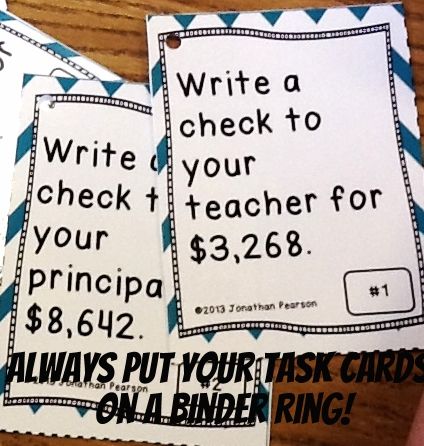
The Importance of Binder Rings

Always put your task cards on a
binder ring!
I shared the other day about introducing my new third grade students to math centers. One of the centers that I introduced was "Check Writing," which has the students writing numbers in standard and written form on a specially designed check that I created just for the center. I made three sets of the task cards on cardstock, cut them out, and laminated them. I carefully put them into three groups (there are 24 task cards in each group) and put the task cards into envelopes for the students to pick up when they chose that center.

Everything was going swimmingly with my centers. At least until clean up time came. Maybe it is just a third grade thing, but clean up seems to be a disaster every day. Children who were behaving wonderfully seem to lose their minds when it comes time to put things away. This is especially true for task cards that come out of envelopes.

Now maybe I wasn't specific when I gave the instructions, but I'm pretty sure that I said to make sure that all cards that come out of envelopes go back into the same envelopes. This, of course, was not the case. When I started to clean up from the day, I noticed that one envelope of cards was very anemic while another envelope looked as if it had just enjoyed a seven course meal. Instead of returning the cards to the correct envelope, the students just shoved the cards into whatever envelope they could find. I even found some of my Check Writing cards in envelopes with Pirates vs. Ninjas, another place value center. I had to sort all of the cards (again!) to make sure they were all there.

So I wised up. I probably should have done this to begin with, but I invested in some binder rings. I put all of the cards on rings. It was beautiful. And the best part? No cards got misplaced! I am a genius. Now, I just need to remember to do it again in the future.


Monday, September 16, 2013

Introducing Math Centers

One of the things that I am big on in teaching math is math centers. My team and I work hard to create some exciting centers for the students. I want them to be practicing the skills that we are teaching, but to do so in such a way that they don't realize they are learning. If the rest of the year continues the way our first day went, I think I might be successful at that.

The first centers I introduced were place value oriented. We have been focusing on the skills of writing numbers (in standard, word, and expanded form), comparing numbers, and rounding numbers. With that in mind, I created a number of centers to help reinforce those skills.


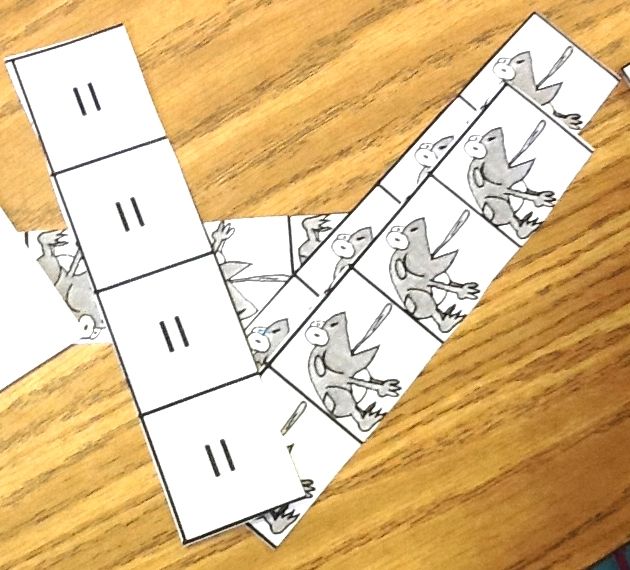
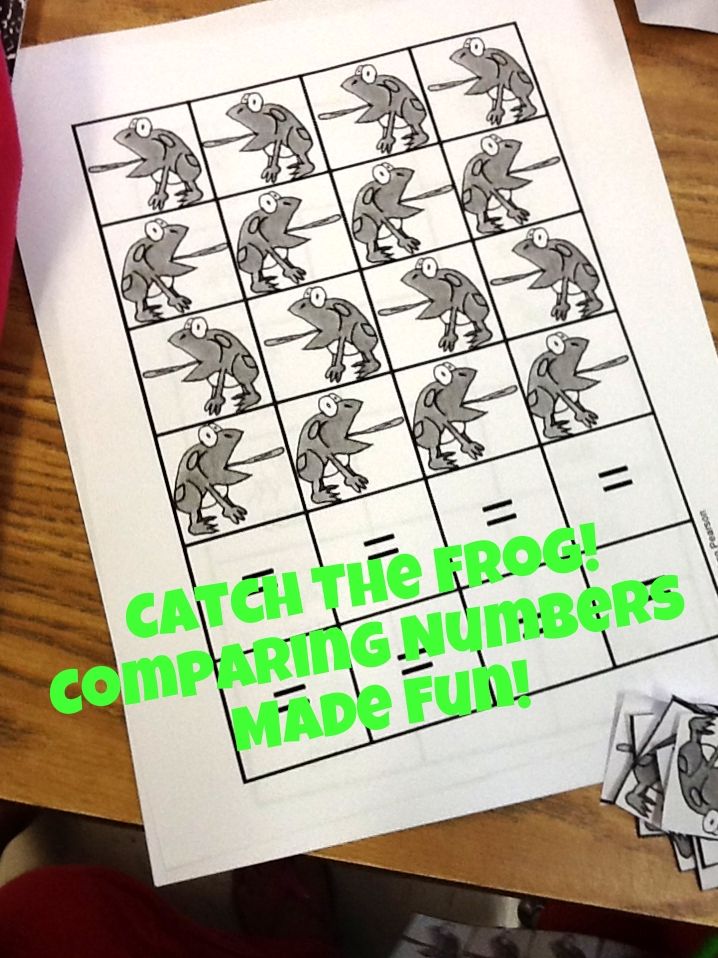
The first center I introduced to the students was something I call "Catch The Fly!" This activity allows the students to compare numbers using the symbols for greater than, less than, or equal to, but does it in a way that encourages a bit of fun. Instead of using the regular (boring) symbols, the center gives students special frog symbols to use. Each of the numbers being compared has a fly over it, so the frog is trying to eat the bigger of the two flies. The students were very excited about this one and were meticulously cutting out their frogs.  The only thing that I would change about this center is the fact that the frogs they are using are black and white.  The actual file has them in color, but that is a lot of color ink to use when making enough sheets for the whole class to use.


Another center that I rolled out for my students today made them feel really grown-up.  This center is called "Check Writing."  The students get to use the skills of writing numbers in standard form and written form to fill out a check for an amount that is listed on the task card they have chosen.  They were so excited to be writing "real" checks, especially when the task card told them to write a check to their teacher.  I did have to correct one student who wrote "My Mom" when the task card instructed her to write a check to her mother.  It did make me laugh.  This center has the students writing four separate checks and the hardest part for them so far was knowing what the date was.  We had to stop and have a mini-lesson on how to use this great new invention known as the calendar.  I just wish the checks they were writing to me were real.

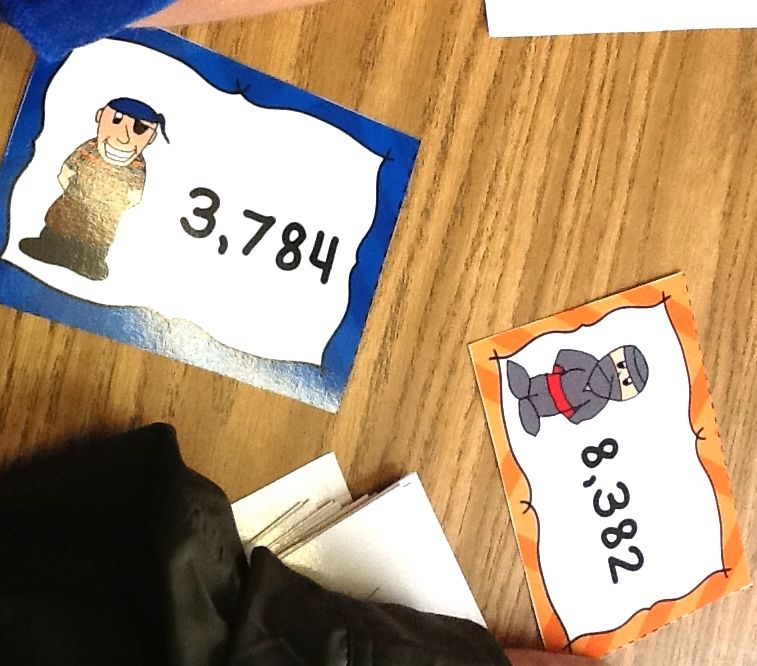
One last center that I want to share with you is the one the students were most excited about.  This center, called "Pirates vs. Ninjas!" has the students comparing numbers, but they are doing it through an exciting card game.  Each student is given a deck of cards and an activity sheet.  With a partner, the student will flip over his card while his partner does the same.  They compare numbers, write down both numbers, and then determine who the winner is.  After 10 rounds, the player with the most wins is the champion.  My students loved this activity because there was a competition aspect to it.  All of the students wanted to play, but as I only made two sets of the cards, this one was in high demand during both math groups.


Each week, I try to have at least nine centers for the the students to choose from.  All of the choices are self-selected, but the students have to complete a certain number of centers before the end of the week.  This is often their favorite part of math time.  I really enjoy seeing them get so excited about applying their learning (even if they don't always realize they are doing it.)

If you are interested in learning more about the centers I shared above, or would like to purchase copies of your own, Catch the Fly!, Pirates vs. Ninjas, and Check Writing are all available for purchase at my TeachersPayTeachers store.  If you make use of them, I would love for you to share how your students responded to the activities.

What centers do your students love the most?

Monday, September 9, 2013

Thinking Like a Scientist - Diet Coke and Mentos

During the first week of school, our third grade students talked about what it means to be a scientist.  We brainstormed and came up with ideas of what a scientist does.  These included saving the environment, building technology, and discovering things.  After we made this list, we drew and colored what the students thought a scientist looked like.  Nearly every kid drew a scientist with gloves, a lab coat, and goggles.

The lessons culminated with a lesson on how a scientist discovers things.  I taught them that a scientist begins by asking a question, sometimes even lots of questions.  After coming up with the question, the scientist develops a hypothesis, what he thinks will happen.  Next, he conducts his experiment and records his data.  Finally, he analyzes the data and comes up with his conclusion and determines if his hypothesis was right or wrong.

The big event for the week was the Diet Coke and Mentos experiment. Many of our families were gracious enough to donate the needed materials. We chose Diet Coke, diet lemon lime soda, and diet root beer. We also used mint-flavored Mentos. Here are some of the results:

Needless to say, the students had a blast participating in the activity, even though I was the one having all the fun. This is a really easy and exciting activity to do and only needs a few materials. There is a website devoted to the science behind this experiment with a lot more videos. The website is called EepyBird.com.

Many of the students were asking me about the special tube I used in the experiment. I used a special tube that attached to the top of the soda bottle and allowed me to load the Mentos into the bottle and pull a string after moving safely away. That tube is called Steve Spangler's Geyser Tube. The Geyser Tube not only kept me dry, it also controlled the flow of the "eruption" from the soda, allowing it to go much higher. The Geyser Tube can be purchased at Amazon.com, but I have also seen them at Cracker Barrel and sometimes at toy stores in the mall.

It was a great first week teaching science and I am looking forward to the exciting things we have planned for teaching matter.

Sunday, September 8, 2013

Using Dice in My Math Classroom

Some of my favorite things to use in my classroom are dice. We use dice for just about everything. They are incredible versatile and be used for nearly every math topic. As I get ready to teach place value, I will definitely be using more dice. And the best part is that my students love to use the dice as well. Of course, we have to have a "mini lesson" on the proper way to use dice (no throwing, no launching into the air, etc.), but, once they know the right way to use the dice, we always have a lot of fun.
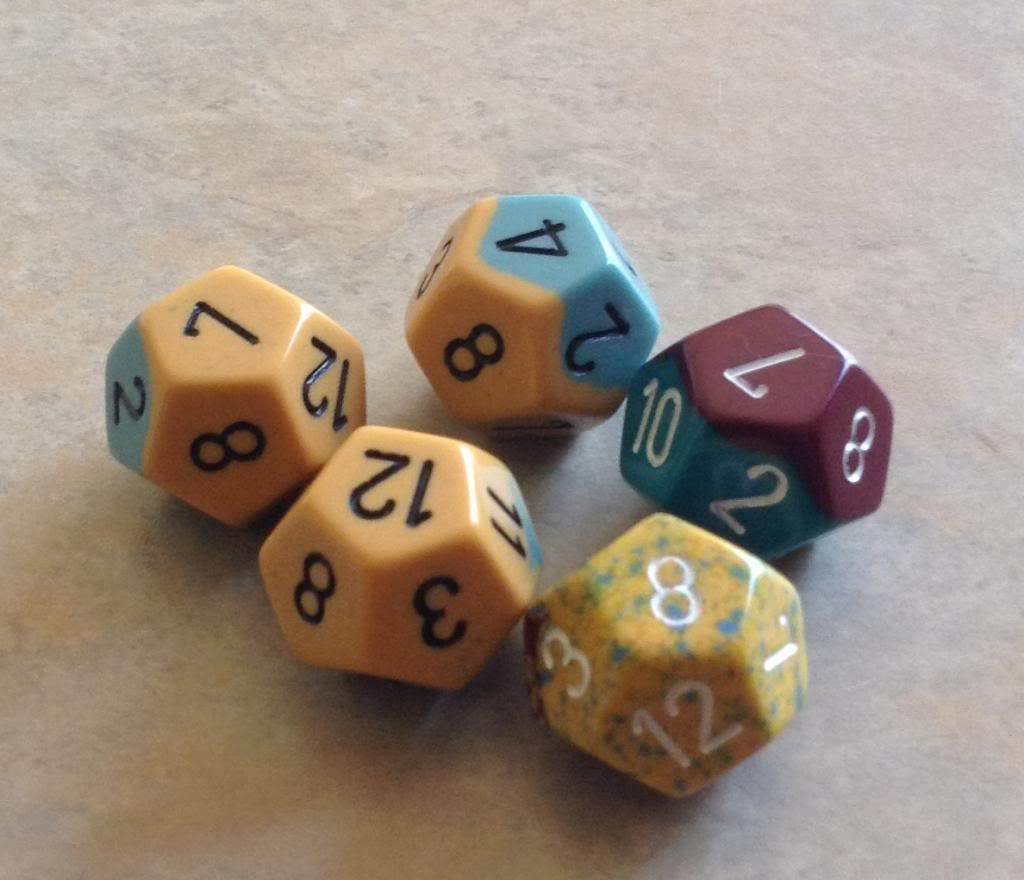
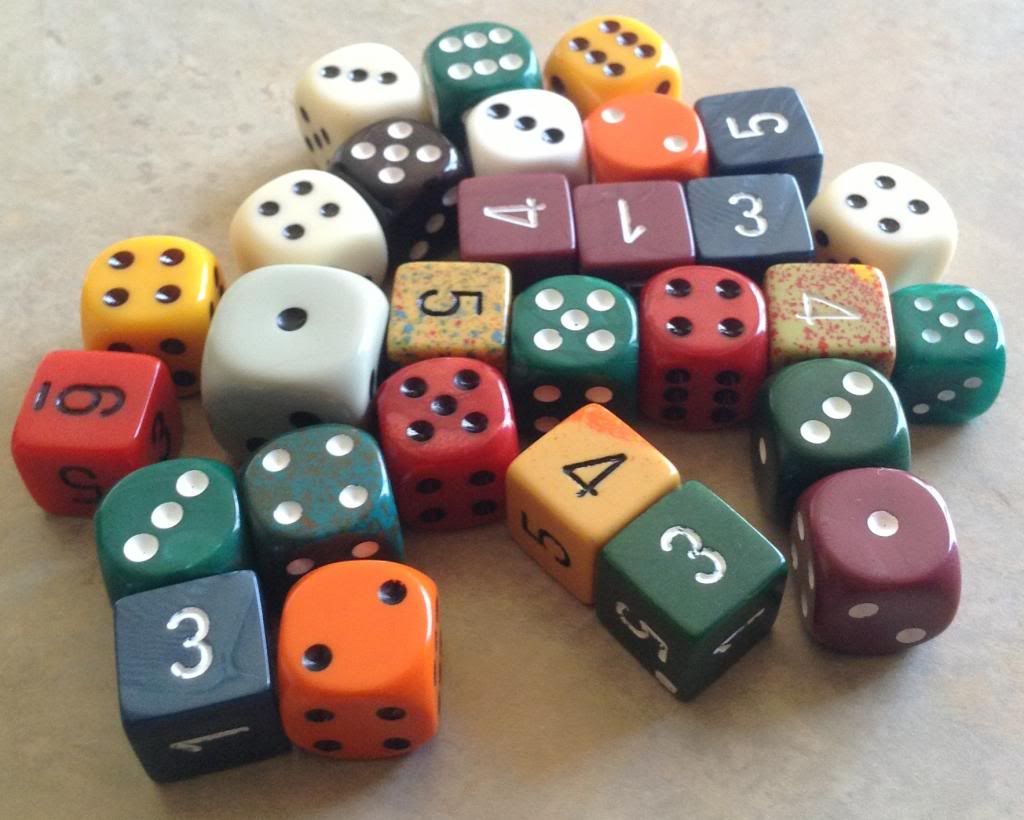
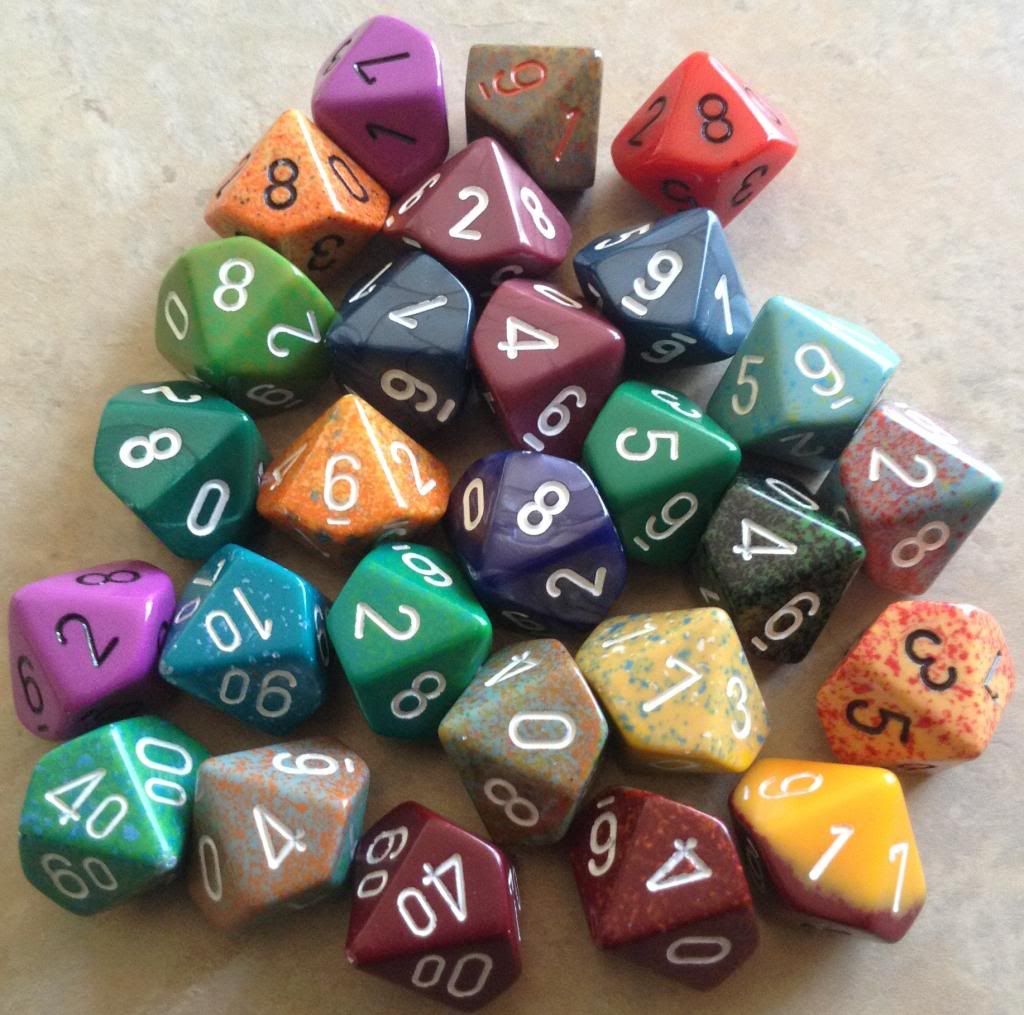
While most people think of just the 6-sided number cube that is used in most games, there are actually a large number of different dice, ranging from 4-sided to 12-sided. In my class, we use 6-sided cubes, 10-sided dice, and 12-sided dice. Here is a list of some of the things I've used dice for in the past.
  • Making numbers for rounding
  • Place value games
  • Addition problems
  • Subtraction problems
  • Multiplication facts
  • Division practice with remainders
The list of ideas is infinite, limited only by your imagination. Dice are a great way to add some rigor and challenge to your students' math skill practice. It definitely beats always giving them worksheets.
The problem that I ran into was the fact that I only have a small number of dice. I think I currently have six of the 10-sided dice and six 12-sided dice, in addition to a number of 6-sided cubes. This limits the number of students who can participate. Unfortunately, the price for the dice were also a bit expensive. At our local teacher supply store, the dice were between $1.50 and $2.00 each. This doesn't sound like a lot, but when you have to buy a lot of them, that price adds up quickly.
The other day on Amazon.com I came across an item called Pound-O-Dice. While I don't know if it exactly 1 pound of dice, I do know that it was exactly what I was looking for! The Pound-O-Dice gave me a huge collection of dice. I received 4-sided, 6-sided, 8-sided, 10-sided, 12-sided, and 20-sided dice. And not just a few. In total, I think I received over 100 dice in the Pound-O-Dice. The price was about $21.00, but I recently receive an Amazon.com gift card for taking an online survey. Even at $21, the Pound-O-Dice was well worth the money.

12-sided dice - Great for multiplication
practice.


The package came with all these
number cubes.

Look at all the 10-sided dice!
What ways do you use dice in your classroom?  Do you students enjoy using them?