Showing posts with label Math Activities. Show all posts

Saturday, March 21, 2015

Graphing Task Cards and a Freebie

*****You can download the free sample of the Bar Graph Posters by clicking here!*****

I have a deep seated hatred of worksheets. I loathe worksheets. This year, I have done my very best to eliminate as many worksheets from my math class as possible. Yes, there are times when we do worksheets, particularly for homework, but, for the most part, worksheets are extinct in Room 19.

That brought me to a sticking point when it came to graphing. I could not figure out how to have my students practice graphing without giving them a worksheet. Then it hit me...task cards! I could make task cards to teach graphing. This way my students could practice reading and analyzing different types of graphs without using a worksheet.

 photo bar graph picture.jpgI made six different full-sized graphs. Each graph was printed on a single sheet of paper. For each graph, I created four questions. Each question was put on its own task card. This made for a total of 24 different questions. I cut out the cards and taped them to the wall under each of the graphs. Small groups of students went into the hall to answer the questions, writing the answers on the recording sheet.


To this point, we have practiced line plots and bar graphs. We will also be working on picture graphs shortly and I will follow the same format. My students really enjoy being able to get up and move around instead of simply staying in their seats.

So you can see what we are doing in my class, I created a free sample of the Bar Graph Posters for you to download. Simply click on the picture below to download your free sample.

 photo Bar Graph Posters Sampler.jpg

If you are interested in the full sets of either the Line Plot Posters or the Bar Graph Posters, they are available for purchase in my Teachers Pay Teachers store.

 photo Line Plots 6 Posters.jpg         photo Bar Graph Posters.jpg

As always, thank you for stopping by. Please feel free to leave a comment below, especially with examples of how you are using the activities with your students.

 photo Signature.png

Tuesday, September 16, 2014

Pirate Math - Pirates vs. Ninjas!

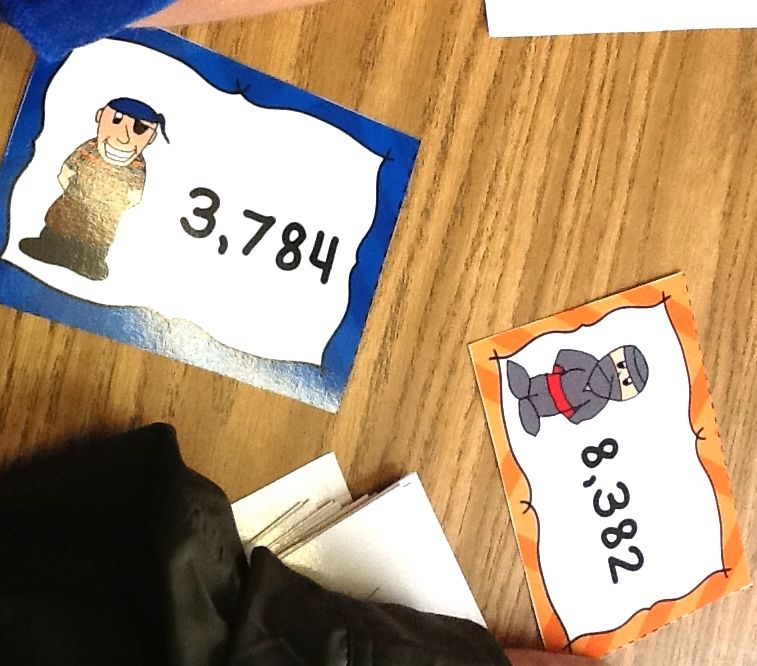
One of the favorite activities in my classroom last year was a surprisingly simple game that I created to help my students practice comparing numbers. It was called "Pirates vs. Ninjas - The Epic Battle Continues!" The title is a play off of an internet activity where people argued about who would win in a battle, pirates or ninjas. I was amazed how many of my students knew about the activity and how sound their arguments were for each side. Then again, these were the kids who knew every character in Lord of the Rings and "Doctor Who."

 photo PiratesCover.jpg

The game came with two decks of cards, one for Pirates and one for Ninjas. Each card had either a 3-digit or 4-digit number. Two students played the game and each one had a deck. Each student would flip over a card from the deck and compare the number with that of his partner. The student with the largest number would collect both cards. After playing through the deck (about 24 cards), the student with the most cards was declared the winner.

 photo PirateGamePic-1.jpg

To help promote accountability and to check for understanding of the skill, I provided the students with a recording sheet. The students were to write down their own numbers and the numbers of their partner. They would then use the inequality symbols (<, >, and =) to indicate if their own numbers were greater than, less than, or equal to the number of their partner. I would collect this sheet and look to see if the students had an understanding of the concept of comparing numbers. Obviously, every student page would be different from the next, but looking at the work turned in provided me with a glimpse of how well each of my students understood the concept.

 photo PirateAnswerSheet.jpg

"Pirates vs. Ninjas!" is really one of my favorite games. Even after we were finished with our place value unit, it was popular during Math Games and Math Centers. I get a lot of feedback on the game and many of the teachers tell me how excited they are to use this game with their boy students. I had girls who loved to play as well. You would do well to add this game to your math classroom.

"Pirates vs. Ninjas! - A Comparing Numbers Game is available in my Teachers Pay Teachers store for $3.00.

For some other great Pirate products, please visit Teaching Momster to see what other teachers are using in their classrooms.

Sunday, August 3, 2014

Guided Math in Action Book Study - Chapter 8

Chapter 8 of Guided Math in Action is the chapter that everyone has been waiting for: this chapter is all about centers!

 photo c9302428-833e-468a-b0a3-0ccd7e294763.png

Because most classes are made up of more than the five or six students that work in a small group, a teacher needs to have a plan for what the other students are going to be doing. In a perfect world, all of the students would sit quietly and engage themselves, but that is certainly not the case in any classroom I have been a part of. To do that, the teacher provides the students with centers, or independent activities that the other students can work on while he is teaching a small group.

Dr. Newton begins the chapter by offering some suggestions about how to set up centers and to keep them organized. These are important to use as guidelines because it will help the centers to run smoothly. We all know that students can't breathe on their own without specific instructions, so the better organized your centers are, the smoother the process will go.

It is also suggested that students work in various types of activities throughout the week. These include individual work, partner work, and group work. During individual work, a student is working on an activity by himself without the help of another student or group. In my classroom, this is when students are doing a math sort or working on task cards. There are times where students may work beside other students, but each student is doing his or her own assignment. When my students are working on task cards, they will often share the set of cards, but each student is doing the problem on the card by himself.

During partner work, students are working together with one other student. During this time, they may be working on a project together, such as a puzzle or matching game. In my classroom, my students will often work together on the Monster Match Fact Family Puzzles. They can also play games against their partners. This is a large part of the centers we do in my classroom. An example would be Pirates vs. Ninjas - A Comparing Numbers Game.

During group work, the students are working together with a bigger group of students. This may involve each student having a role in the group. Dr. Newton described each student in the group having a role in solving story problems, such as number cruncher, illustrator, and problem checker. Students can also play competitive games against others in their group. A wonderful teacher named Rachel Lynette has created a set of game boards that she offers for free in her Teachers Pay Teachers store. These boards are excellent for use in group work. My students love playing them.

Dr. Newton also gives a list of the seven centers she believes should be in every math classroom.

  1. Basic Fact Center - students are practicing math facts.
  2. Hot Topic Review Center - students are practicing and reviewing skills taught up to that point in the year.
  3. Geometry Center - students are exploring shapes
  4. Word Problem Center - students are working to solve story problems at the pictorial, concrete, and abstract level
  5. Math Poem Center - students are working with math poems and other written materials
  6. Math Journal Center - students are working on math journals, including foldables and other activities
  7. Math Vocabulary Center - students are practicing with math vocabulary

Chapter 8 was the most exciting chapter because this is an area that all teachers want to improve in. Dr. Newton offered a number of great examples and ideas for getting centers up and running so that small groups can take place

 photo ac8281b3-1fa3-4211-bc31-aa936be08d43.png

Question 1: The majority of my math centers are individual activities or partner activities. My students play many math games (especially ones that will help them improve their fact fluency) and work on sorts, cutting activities, or task cards. There are some times when there is group work involved (making graphs, using measurement tools), but not as much as I would like. I hope to make it a goal this year to introduce groups to solving story problems. This may make for a great small group lesson (introducing the procedures and modeling the steps) before adding it as a center.

Question 2: At the present time, my students are accountable for their centers work through something I call the Centers Grid. The centers that we are working on for that time period are listed on a grid. I will often assign three or four "required" centers and allow the students to choose 2-3 others. The majority of the centers have a student recording sheet that goes with the activity (this is especially true of the Scavenger Hunts or task cards). I did like the idea that was introduced in the chapter of calling on students to share what they completed during centers. I am also going to be making reflection sheets for my students to use a few times a week to share what they have done in centers and what they are learning. Dr. Newton provided three different examples of forms, each becoming increasingly more involved. I hope to add reflection like this to my math classroom next year.

School starts in just a few weeks (or days, depending), so I hope you are getting some great ideas from this series on how to run your math class for next year.

Here are some other great blogs to check out their thoughts on this chapter.

Tuesday, July 29, 2014

Two for Tuesday - Great Place Value Activities 50% Off Until Friday

It's Tuesday, so that means it must be time for another...

Two for Tuesday

 photo 86029bf5-9d53-4f53-bd8a-c0e188cafb63.png

To celebrate the fact that it's Tuesday (and school is about to start for most of us...sad but true), I've put two of my place value activities on sale for 50% off until Friday, August 1! Just click on any of the pictures below to go to my Teachers Pay Teachers store to take advantage of these great offers.

Place Value Scavenger Hunt

The first activity I have listed is the Place Value Scavenger Hunt. My students loved Scavenger Hunts! This particular activity had 28 questions that were related to place value concepts. The students were asked to round numbers, compare numbers, and write the numbers in different formats (standard, written, and expanded form). Each of the cards has a unique QR code associated with it.

The Place Value Scavenger Hunt makes a great center. I prepare the cards on cardstock and laminate them for durability. Then I cut out the cards and hang them randomly around the classroom. The students use the included recording sheet to write their answers down. After completing the activity, the students would use the classroom iPad to scan the QR codes using an app installed on the iPad. The QR code would provide the students with the correct answer, making the activity self-checking. Of course, the Scavenger Hunt can be used without an iPad as well.

This product normally sells for $3.50, but you can purchase it through Friday for just $1.75.

Check Writing - A Place Value Activity

The second activity is Check Writing - A Place Value Number Writing Activity. This activity is designed to student to the real world concept of check writing. The students are given the option of choosing from 24 different task cards and they are also given a blank check. The students are to fill out the check with the information on the card.

This was one of my students' favorite activities during our place value unit. They felt so grown up writing checks to me, their parents, and to the principal. One student even asked if she could take her checks to the principal. Too bad the checks weren't real.

Check Writing normally sells for $3.00, but, until Friday, it is on sale for $1.50. Please don't miss out and definitely share this with your friends and fellow teachers.

These are great activities to start the school year with, especially if your first unit is place value. You can also visit my Teachers Pay Teachers store for other great math activities. You can also follow my store to get updates when new products are available.

Sunday, July 27, 2014

Guided Math in Action Book Study - Chapter 6

Chapter 6 is all about how to plan a Guided Math lesson. It was relatively short, but there was some really good stuff inside. I especially enjoyed the "peek in" of a Guided Math lesson.

 photo c4590c5e-5359-4dee-9f10-02f050925a50.png

Dr. Newton provides a framework for guided math that is broken into 3 sections. These sections include the mini-lesson, student practice, and share time.

  • Mini-Lesson In the mini-lesson, it is our job as teachers to hook the students into that day's learning. We do this by making some kind of connection. I like to make the connection by telling a story. My students love to hear stories about my life or when I was a student in college and I always do my best to tie the story back to the lesson. After the hook, it is time to demonstrate the material.
  • Student Practice After the teacher demonstration, it is time for the students to practice the skill being taught. This is the part of the lesson where the teacher and the student interact and discuss what they are doing as they work through the lesson. This would be a time for using whiteboards or playing games.
  • Share Time The final part of the lesson is the share time, where students are asked questions about what they did during their practice time. Students can be interviewed one at a time or they can be asked to retell the main points of the lesson. The share time is then concluded by reinforcing the concepts one more time to clarify any confusion the students may have. The math centers are then explained and that group of students is released to go work.

The key take-away from this chapter is the need to plan out the lessons. Guided math is not something that can be done by the seat of your pants. It takes careful planning to be effective

 photo 54bde1c8-6715-4dc4-beea-4a738f98707a.png

Question 1: I have never been one to use a Guided Math lesson plan. Because of the way I build my small groups, I tend to do many of the same things each time I meet with a group. The key thing is that I already include all of the aspects of a guided math lesson when I meet with my small groups. We begin by reviewing the material. I show the students a couple of examples. The students are then given the opportunity to practice the lessons. Finally, we discuss what was done. I would like to become more conscientious about doing a more formal plan.

Question 2: When teaching from the concrete to the pictorial to the abstract, I always start with manipulatives. This can include base-10 blocks or coins or even cards. The students need something to hold in their hands. After they are used to moving the objects around, I show them how to draw pictures. A good example of this is showing the students how to draw arrays for multiplication. I also show the students how to use large squares, lines, and dots when using base-10 numbers. I have a blog post that I really need to write on how I teach my students to solve multiplication problems. I've been trying to write it for months.


It's hard to believe that we are almost finished with this book. Be sure to leave a comment about how you plan your guided math lessons or ways that you move from concrete to pictorial. I would love to hear some new ideas.

Saturday, July 26, 2014

Teaching Multiplication With Arrays and a Freebie

I have a confession. I absolutely love teaching multiplication with arrays. I love to draw them and I love to see my students drawing them, especially when they are attempting to solve a fact that they have not memorized yet. One of the projects that I am excited to have my students work on this coming school year is a giant multiplication chart where each space on the chart is filled with an array. I'll post pictures if/when we get it finished.

I realize that arrays may not be the most time efficient way of solving multiplication facts, especially when you get to larger facts like 11x12 or 12x10, but I think they provide students enough support and scaffolding as they learn their "smaller" facts to provide the foundation for those "bigger" facts.

 photo f628f16c-1ce1-45ed-abdf-959d460b0046.jpg

One of the games that I will often have my students play in math centers (regardless of the topic) is Matching. Some people call it Memory, but I think that term may be copyrighted, so I call it Matching. The way the game is played is to have all of the cards turned face down on the table or floor. Students take turns flipping over two cards at a time. If the two cards are a match, the student keeps the cards. If not, he has to turn them back over. The key to the game is to keep an eye on the cards that have been flipped so that when a player's turn comes up, he can flip over cards he already knows. The player that makes the most matches is the winner.

 photo 5c3f2468-11eb-4864-bf01-5b1eb9ac9182.jpg          photo 6c0179c1-2459-4ea2-99e6-35e4aabbbf16.jpg

I created a small freebie of this game and I want you to have it. Obviously you can use it as a Matching Game, but there are many different uses for it. If you do use it as a Matching Game, I would recommend printing it on card stock, but you probably know that already. Just click on the image below and it will download the activity.

If you are looking for other multiplication activities, I have several available in my Teachers Pay Teachers store. To take a look, click on the images below and it will take you to the product for more information.

I hope that you enjoy the freebie and I would love to hear how it works for you. Please leave a comment below to let me know how it is working for you and your classroom. You can also follow my blog or follow me on Facebook for other updates.

Tuesday, July 22, 2014

Two for Tuesday - Save 50% Through Friday

Today, I'm going to do something different. I'm going to offer two of my best-selling products from my Teachers Pay Teachers store at 50% of the regular price. I don't usually sell my products here on my blog (at least not this blatantly), so that's why it is different. So, I am linking up with the wonderful ladies of The Teaching Tribune for Two for Tuesday.

 photo 86029bf5-9d53-4f53-bd8a-c0e188cafb63.png

Subtraction Across Zeroes Task Cards

The first product is a set of task cards to help students practice subtracting across zeroes. A number of my students had difficulty with this particular topic, so I wanted to make something for them so that they could have extra practice during centers. It turned out that this product struck a nerve with others and it has sold more than any other product in my store. I recently updated the product and added several other items to it. Subtraction Across Zeroes sells for $4.00, but through Friday, July 25, it is on sale for 50%.

Identifying Fractions on a Number Line

The other product that is on sale is Identifying Fractions on a Number Line. To be honest, I was pleasantly surprised that this activity has been so popular. This is a set of 32 task cards that ask students to identify a fraction based on where the X is on the number line. It can be challenging because students have to determine how many sections the line has been divided into (the denominator) and find the position of the X (the numerator). This set of cards (like all of my task cards) are perfect for play Scoot, scavenger hunts, math centers, or for use in small groups. Identifying Fractions on a Number Line is normally $3.00, but is marked down to $1.50 until Friday.

I know that most of us still have a couple of weeks before school starts, but it is never too early to start planning ahead, especially when you can get an awesome deal like this. Hurry, these special prices are only available until Friday, July 25. And, while you are looking for great deals, be sure to head over to The Teaching Tribune to see other great offers.

Sunday, July 20, 2014

Guided Math in Action Book Study - Chapter 3

Follow my blog with Bloglovin

 photo ebd17667-be1e-4101-b862-e1810a6aa410.png

Today's post is supposed to be about Chapters 3 and 4 from Guided Math in Action by Dr. Nicki Newton (have I told you that you should probably own a copy of this book?) However, my family had a pretty dramatic event take place this week and I was only able to prepare my thoughts for Chapter 3.

What was the event you ask? Well, my wife gave birth to a little girl on Friday afternoon. Catherine "Kate" Alice Pearson is now a member of the family. Isn't she beautiful?

So, while my wife has been recovering the hospital and getting acquainted with our new little one and her eating and sleeping and pooping habits, I have been at home taking care of our other four children. My wife and I are the proud parents of 4 boys (ages 8, 6, 3, and 2). Needless to say, there has not been a lot of time for reading and writing over the past couple of days. With that in mind, I hope that you will allow me some leeway with this post.


Chapter 3 is all about setting up the Guided Math framework. Dr. Newton is big on Math Workshop, but, as I've said before, you can use whatever math framework works best in your particular context. Right from the start, Dr. Newton makes it abundantly clear that you have to start with the routines from the very beginning. Students thrive on routine. The sooner you can get your routine established, the easier it will be to have the students follow along.

Among the first things to establish are the rules, consequences, and rewards. Students need to know what is expected of them when they are working in math. We need to make sure that there are positive expectations for the students and that they are clearly posted so that there is no disagreement about what needs to be done. The consequences for breaking those rules must also be established and followed. Finally, the students need to know the rewards. The key that Dr. Newton pointed out was not to "bankrupt" the system. If the students earn the points, they need to know that those points aren't going to be lost.

The other key aspect of the chapter is to build a teacher's toolkit. A toolkit is supposed to be at your meeting area so that you are completely prepared when your groups come back to work. The toolkit should include folders that include examples of student work, materials for keeping anecdotal records on the students, papers, pencils, different supplies like scissors and glue, and manipulatives like cards, dice, and rubber bands.

Now to the questions:

 photo 0972c70a-ed0a-4cf7-9a37-0be007531766.png

Do you have a teacher's toolkit? At this point, I don't a specific "toolkit." Having read this, I am going to work on putting together the necessary items that would be included in a toolkit. My friend Sarah has a great post about what she includes in her toolkit. You may want to take a look at her post to get some more ideas about what to include in your own toolkit.

Do your students have toolkits? All of our materials are kept in a central location. I have a cubby cart that holds all of the number cards, dice, and math games that the students may need when working at centers. This cart also has the rulers and crayons, as well as extra pencils and glue sticks. I do need to figure out a better way to organize the pencils and the glue sticks because I honestly think my students were eating them. I have never gone through as many glue sticks as I did last year.

How do you establish routines/expectations? I make my expectations and routines known from the first day. My students are told the routines, they tell the routines to each other, and they repeat the routines back to me. After that we practice the routines and if they aren't done correctly (which they typically aren't), we do them again. It usually only takes a few times of doing it over for the students to get the idea of what is expected. Additionally, I also make signs to hang up so that the students will have a constant reminder of what they should be doing.


Well, that brings us to the end of another chapter. Please be sure to read the other blogs that are participating, especially since my post is missing Chapter 4. And, like most of have said, if you haven't gotten a copy of the book yet, you really should. Amazon.com has a pretty good price on it.

Thursday, June 26, 2014

Three Resources I'm Excited About!

You probably already know this, but the internet is pretty awesome. Especially when it comes to finding resources and ideas for your classroom. I have no idea how teachers can be in the classroom these days and not be aware of all of the great things that are available. I know a teacher who absolutely refuses to join Pinterest and very rarely utilizes Teachers Pay Teachers. How is that even possible? Blows my mind.

With that being said, here are three resources that I am pretty excited to use for the coming year. I hope that you will find them useful.

  • Task Card Corner. I love task cards. My Teachers Pay Teachers store is full of the task cards that I made for my students to use during math centers. Each week they would come in and ask if I had more cards for them to use. Task Card Corner is a blog with tons of ways to use task cards. I can't wait to try these ideas out when school starts up again.
  • Guided Math Adventures. I am currently working my way through Guided Math: A Framework for Mathematics Instruction by Laney Sammons. There are some really great ideas in the book (I think I may have to read it more than once) that will be awesome to begin implementing this fall. The teachers over at Guided Math Adventures are going to be sharing some of their resources and ideas. It is a new blog, so there isn't a lot of content yet, but I am excited about what is to come. Be sure to give them a follow.

  • LuckeyFrog's Lilypad Pinterest page. My friend who writes LuckeyFrog's Lilypad has an incredible collection of Pinterest boards. Her job is a reading specialist (update: I just read that she is a fourth grade science/social studies teacher in the fall), but she has some really great stuff for all areas (including math). Definitely go follow her on Pinterest (you can follow me too by clicking here or by using the social media buttons on the side).

I hope you find these resources helpful. I know there are millions of resources out there. I hope I can find them and share them. If you find some great places or ideas, please share them with me and with others. Teaching is a collaborative sport, right?

Tuesday, October 22, 2013

Freebie - Subtraction Bingo


My classes are currently studying subtraction in our math classes. One of the ways that I like to have students practice is through a lot of different interesting centers. One of the centers that they are working on for the Subtraction Unit is called Subtraction Bingo. When I explained the activity to my students they seemed very excited to get started on putting the game together.


 The first thing the students have to do is answer the subtraction problems that will be used to create the Bingo board. There are 25 different subtraction problems for them to solve. These problems focus on 3-digit subtraction, with and without regrouping. This is probably as close as I get to a math worksheet outside of the homework I assign each evening. The problems that the students solve will be used as the spaces on the Subtraction Bingo board.


After the students solve the 25 problems, the questions are cut apart from each other. The students will need to choose 24 of the 25 problems to create their Bingo boards. Once the problems have been cut apart, the students will use a glue stick to glue the problems to the 24 spaces on the empty Bingo board. This lets the students create their own boards and each board will be different.


When the students have created their boards, it is Bingo Time! I have all of the differences on little cards in an envelope. The students take turns pulling out the differences and reading them aloud. If a student has that number on his board, he gets to cover it with a marker. The first student to cover five spaces in a row is the winner.

Subtraction Bingo is a lot of fun and I want your students to enjoy the activity as well, so I have made it free from my Teachers Pay Teachers store. I hope you can use it and would love to know how it worked in your classroom. Hopefully it will be as a big a hit in your room as it is in mine.


Monday, October 21, 2013

Monday Math - Earth! Water! Fire! and Switch! - Exciting Math Games for 3rd Grade

Today is the first installment of what I hope will be an ongoing series. I'm trying my hand at doing a video each week to highlight something I am doing with my math students. This week I am sharing with you two of the math games that we are currently using in my math class.

The first activity that I share is called Switch!. The set my students are using is designed to help them develop some mental addition skills. I don't think they realize what they are learning. All I know is that I have three sets of the game in my room and all three sets are in high demand.

The second activity that gets highlighted this week is Earth! Water! Fire! This particular game is similar to Paper, Rock, Scissors, but with a slight twist. There are three sets in my classroom right now, all focusing on multiplication facts. It is my sincere hope that I will have a whole classroom of students who are fluent in their multiplication facts...before we even start teaching multiplication next quarter. I'll be making other sets soon to focus on division facts as well.

Please leave me some feedback on the video. I would love to hear what you liked and what I could do better next time.

If you are interested in any of the products I shared today, please be sure to visit my Teachers Pay Teachers store to get more information on how you can add them to your classroom.

Tuesday, October 8, 2013

Using Scavenger Hunts in Math

I am a big believer in having my students engaged as much as possible when they are practicing math skills. My team uses a centers-based teaching framework so that we meet with smaller groups of students. To do this, we need incredibly engaging activities for the other students to be working on. This is a strong area for me and something that I love doing.

One of the centers that my students love the most is the math scavenger hunt. A scavenger hunt is an activity where I scatter review questions around the classroom and the students have to look around and locate the questions. The questions are not hidden in difficult places, but I do try to mix up the numbers of the questions. Question 5 might be hung next to question 22.

Right now, my students are working on completing an addition scavenger hunt. There are 22 questions (covering all of the skills we are teaching in this unit) hung up around the classroom. My students go from question to question, answering as they go. It is fun to see if they will answer the questions as they find them or to watch them hunt around and try to do the questions in order. Each scavenger hunt has an answer sheet for the students to record their answers on (in case I need a formative assessment or something). Before the Addition Scavenger Hunt, we did a Place Value Scavenger Hunt. When I passed out our Centers Grid for the week, they (both classes) were very excited to see the Scavenger Hunt on there.

If you are interested in using a Scavenger Hunt in your classroom, the hunts that I have made are available from Teachers Pay Teachers. I also included a QR code on each question, so students using iPads or iPods can check to see if they got the answer correct. It is a lot of fun and very engaging for the students.

The Addition Scavenger Hunt and the Place Value Scavenger Hunt are available at my TeachersPayTeachers store, along with many other math activities and games.  I would love for you to check out the products I have available.  I would also love to know what centers you use in your math time.  Please leave a comment below to let me know what your students love doing to help them practice their math skills.


Tuesday, September 17, 2013

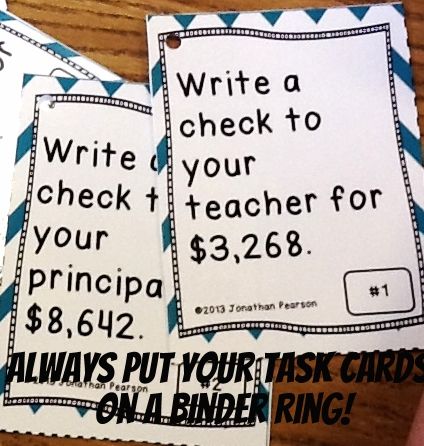
The Importance of Binder Rings

Always put your task cards on a
binder ring!
I shared the other day about introducing my new third grade students to math centers. One of the centers that I introduced was "Check Writing," which has the students writing numbers in standard and written form on a specially designed check that I created just for the center. I made three sets of the task cards on cardstock, cut them out, and laminated them. I carefully put them into three groups (there are 24 task cards in each group) and put the task cards into envelopes for the students to pick up when they chose that center.

Everything was going swimmingly with my centers. At least until clean up time came. Maybe it is just a third grade thing, but clean up seems to be a disaster every day. Children who were behaving wonderfully seem to lose their minds when it comes time to put things away. This is especially true for task cards that come out of envelopes.

Now maybe I wasn't specific when I gave the instructions, but I'm pretty sure that I said to make sure that all cards that come out of envelopes go back into the same envelopes. This, of course, was not the case. When I started to clean up from the day, I noticed that one envelope of cards was very anemic while another envelope looked as if it had just enjoyed a seven course meal. Instead of returning the cards to the correct envelope, the students just shoved the cards into whatever envelope they could find. I even found some of my Check Writing cards in envelopes with Pirates vs. Ninjas, another place value center. I had to sort all of the cards (again!) to make sure they were all there.

So I wised up. I probably should have done this to begin with, but I invested in some binder rings. I put all of the cards on rings. It was beautiful. And the best part? No cards got misplaced! I am a genius. Now, I just need to remember to do it again in the future.


Monday, September 16, 2013

Introducing Math Centers

One of the things that I am big on in teaching math is math centers. My team and I work hard to create some exciting centers for the students. I want them to be practicing the skills that we are teaching, but to do so in such a way that they don't realize they are learning. If the rest of the year continues the way our first day went, I think I might be successful at that.

The first centers I introduced were place value oriented. We have been focusing on the skills of writing numbers (in standard, word, and expanded form), comparing numbers, and rounding numbers. With that in mind, I created a number of centers to help reinforce those skills.


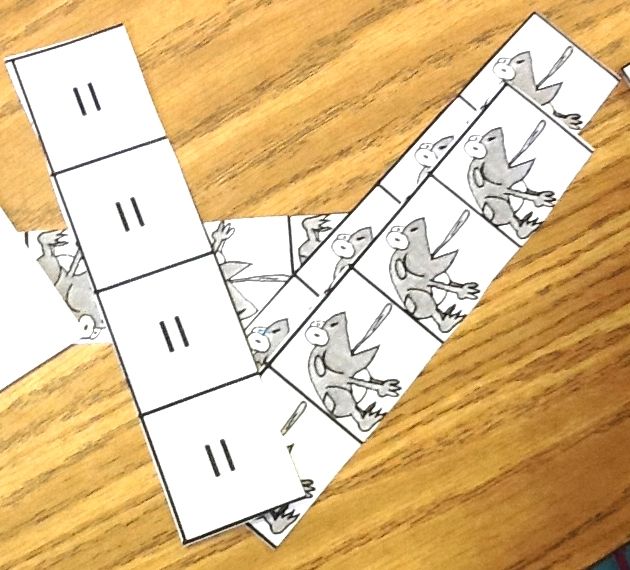
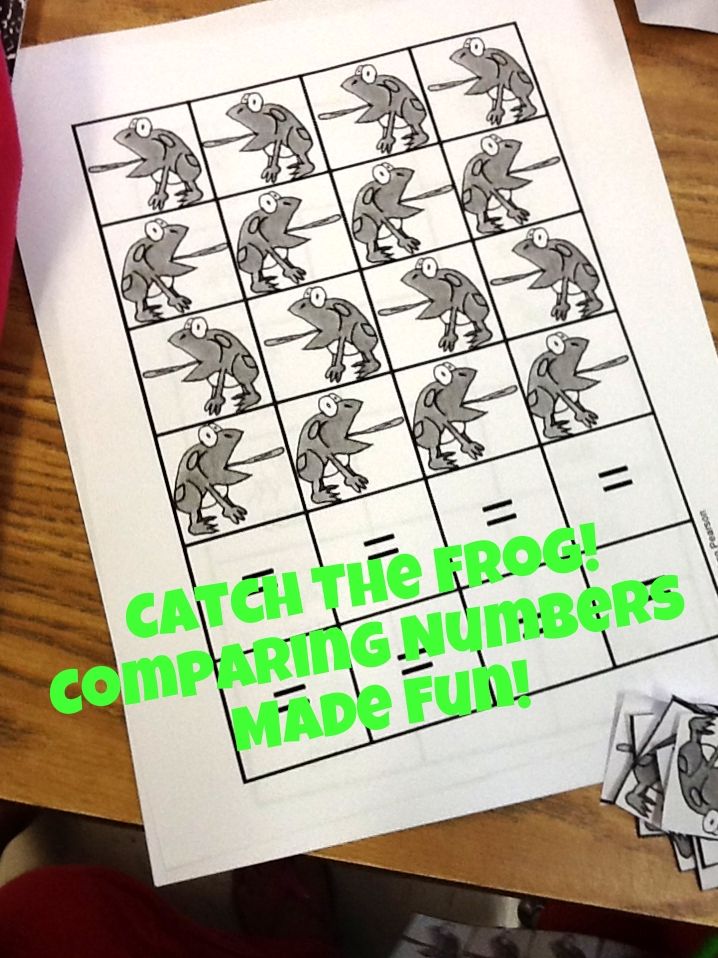
The first center I introduced to the students was something I call "Catch The Fly!" This activity allows the students to compare numbers using the symbols for greater than, less than, or equal to, but does it in a way that encourages a bit of fun. Instead of using the regular (boring) symbols, the center gives students special frog symbols to use. Each of the numbers being compared has a fly over it, so the frog is trying to eat the bigger of the two flies. The students were very excited about this one and were meticulously cutting out their frogs.  The only thing that I would change about this center is the fact that the frogs they are using are black and white.  The actual file has them in color, but that is a lot of color ink to use when making enough sheets for the whole class to use.


Another center that I rolled out for my students today made them feel really grown-up.  This center is called "Check Writing."  The students get to use the skills of writing numbers in standard form and written form to fill out a check for an amount that is listed on the task card they have chosen.  They were so excited to be writing "real" checks, especially when the task card told them to write a check to their teacher.  I did have to correct one student who wrote "My Mom" when the task card instructed her to write a check to her mother.  It did make me laugh.  This center has the students writing four separate checks and the hardest part for them so far was knowing what the date was.  We had to stop and have a mini-lesson on how to use this great new invention known as the calendar.  I just wish the checks they were writing to me were real.

One last center that I want to share with you is the one the students were most excited about.  This center, called "Pirates vs. Ninjas!" has the students comparing numbers, but they are doing it through an exciting card game.  Each student is given a deck of cards and an activity sheet.  With a partner, the student will flip over his card while his partner does the same.  They compare numbers, write down both numbers, and then determine who the winner is.  After 10 rounds, the player with the most wins is the champion.  My students loved this activity because there was a competition aspect to it.  All of the students wanted to play, but as I only made two sets of the cards, this one was in high demand during both math groups.


Each week, I try to have at least nine centers for the the students to choose from.  All of the choices are self-selected, but the students have to complete a certain number of centers before the end of the week.  This is often their favorite part of math time.  I really enjoy seeing them get so excited about applying their learning (even if they don't always realize they are doing it.)

If you are interested in learning more about the centers I shared above, or would like to purchase copies of your own, Catch the Fly!, Pirates vs. Ninjas, and Check Writing are all available for purchase at my TeachersPayTeachers store.  If you make use of them, I would love for you to share how your students responded to the activities.

What centers do your students love the most?

Sunday, September 8, 2013

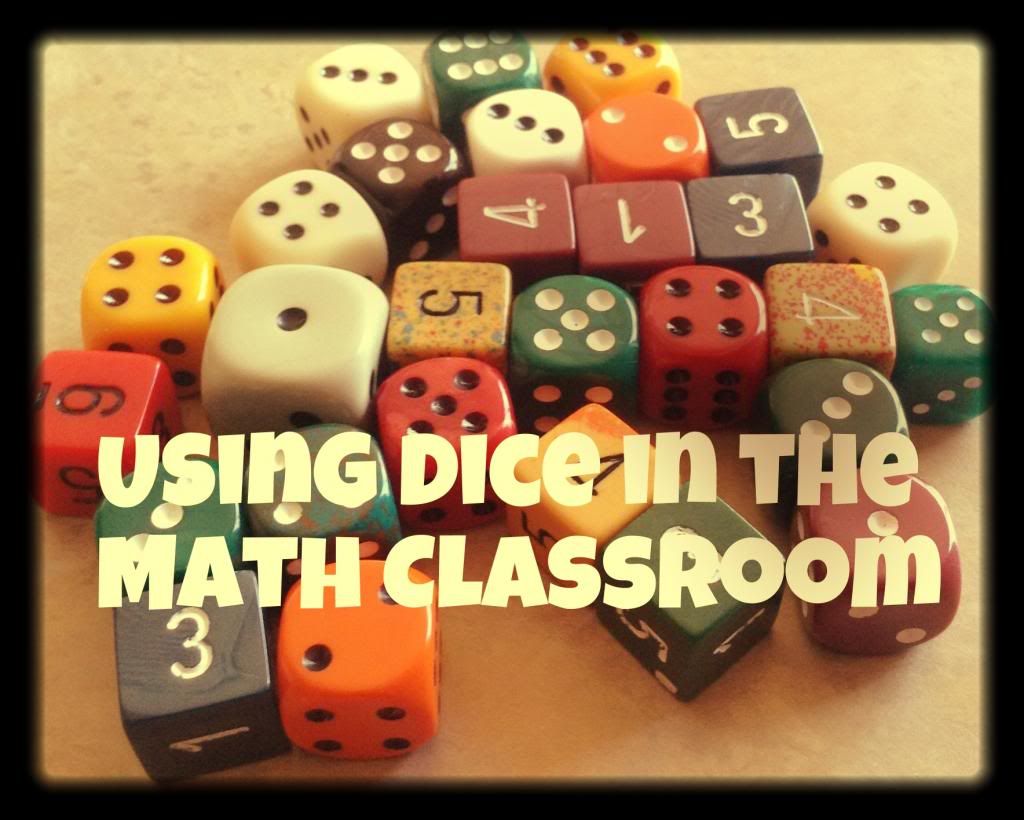
Using Dice in My Math Classroom

Some of my favorite things to use in my classroom are dice. We use dice for just about everything. They are incredible versatile and be used for nearly every math topic. As I get ready to teach place value, I will definitely be using more dice. And the best part is that my students love to use the dice as well. Of course, we have to have a "mini lesson" on the proper way to use dice (no throwing, no launching into the air, etc.), but, once they know the right way to use the dice, we always have a lot of fun.
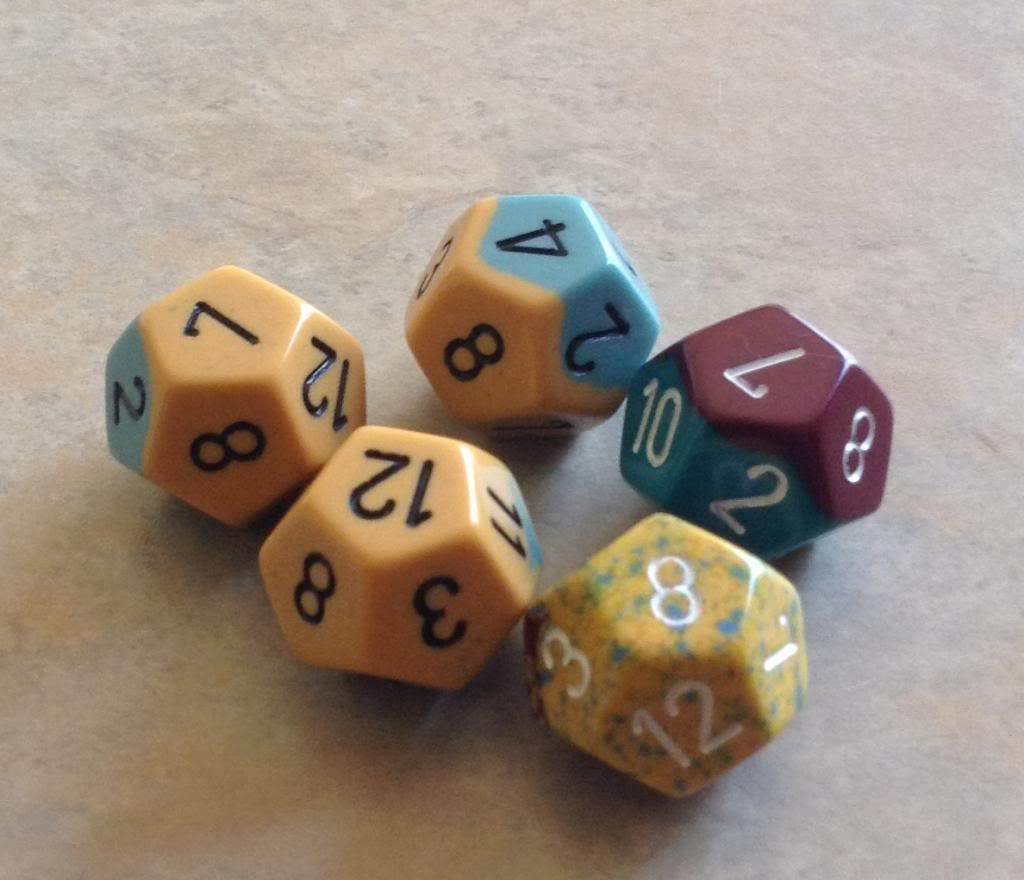
While most people think of just the 6-sided number cube that is used in most games, there are actually a large number of different dice, ranging from 4-sided to 12-sided. In my class, we use 6-sided cubes, 10-sided dice, and 12-sided dice. Here is a list of some of the things I've used dice for in the past.
  • Making numbers for rounding
  • Place value games
  • Addition problems
  • Subtraction problems
  • Multiplication facts
  • Division practice with remainders
The list of ideas is infinite, limited only by your imagination. Dice are a great way to add some rigor and challenge to your students' math skill practice. It definitely beats always giving them worksheets.
The problem that I ran into was the fact that I only have a small number of dice. I think I currently have six of the 10-sided dice and six 12-sided dice, in addition to a number of 6-sided cubes. This limits the number of students who can participate. Unfortunately, the price for the dice were also a bit expensive. At our local teacher supply store, the dice were between $1.50 and $2.00 each. This doesn't sound like a lot, but when you have to buy a lot of them, that price adds up quickly.
The other day on Amazon.com I came across an item called Pound-O-Dice. While I don't know if it exactly 1 pound of dice, I do know that it was exactly what I was looking for! The Pound-O-Dice gave me a huge collection of dice. I received 4-sided, 6-sided, 8-sided, 10-sided, 12-sided, and 20-sided dice. And not just a few. In total, I think I received over 100 dice in the Pound-O-Dice. The price was about $21.00, but I recently receive an Amazon.com gift card for taking an online survey. Even at $21, the Pound-O-Dice was well worth the money.

12-sided dice - Great for multiplication
practice.


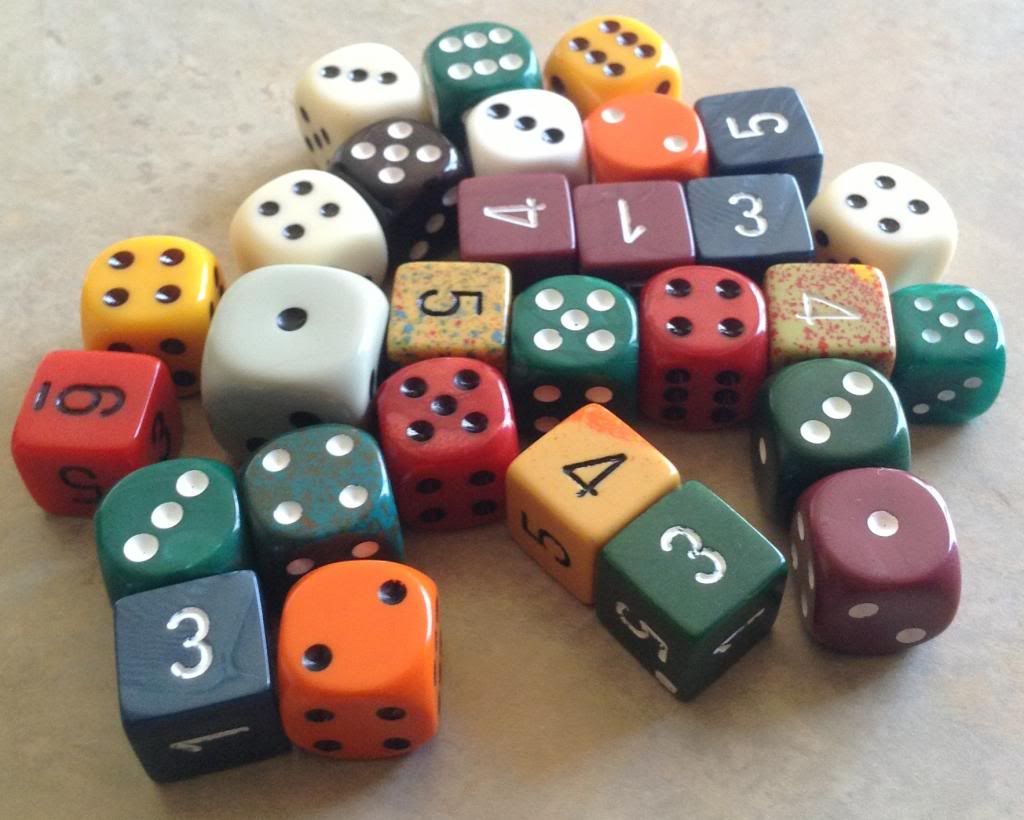
The package came with all these
number cubes.

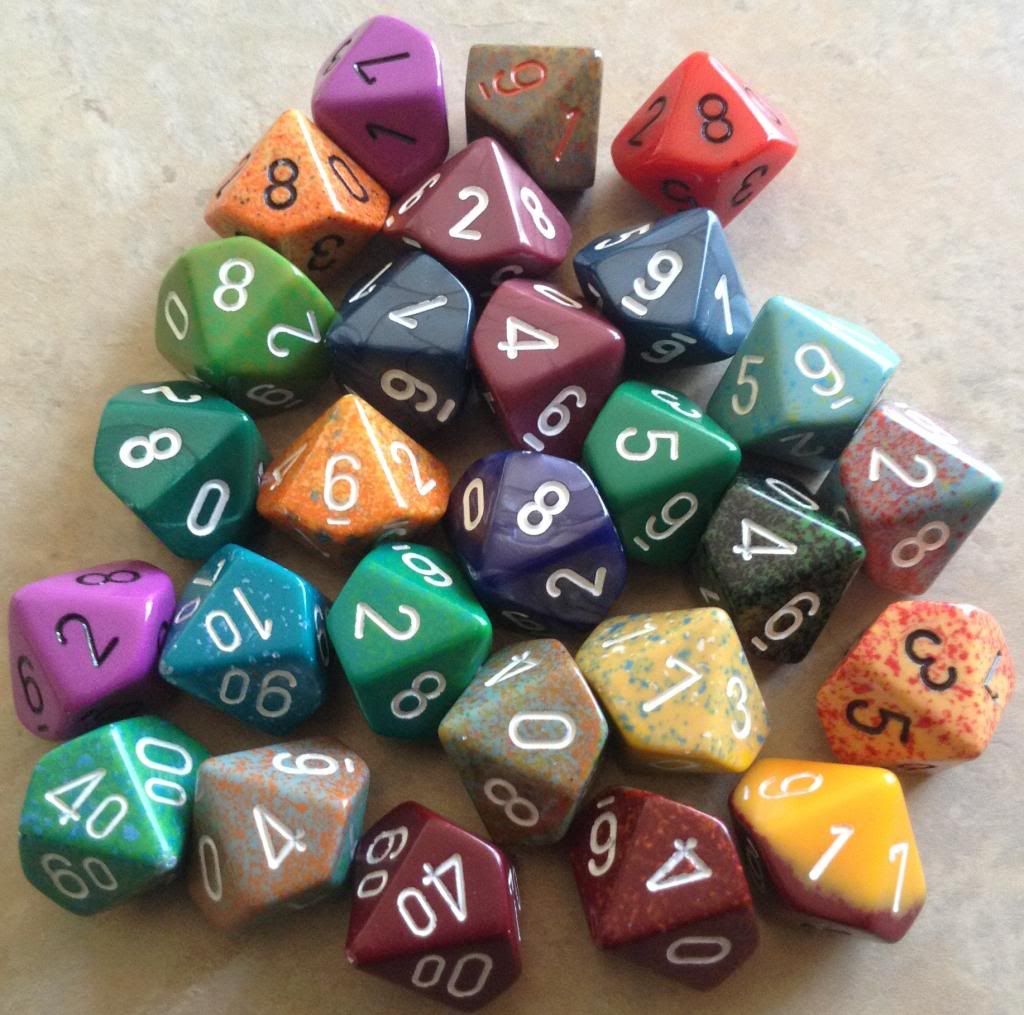
Look at all the 10-sided dice!
What ways do you use dice in your classroom?  Do you students enjoy using them?