Sunday, March 23, 2014

Free Measurement Tools Activity Sheets

My students and I will be beginning a unit on measurement this week in our math classes. A few of the lessons we will be doing will be on knowing which tool is appropriate for the task. For example, one would use a scale to find mass or a ruler to find length. I am also introducing words like scale, graduated cylinder, and volume.

To go along with these lessons, I made a few activities to help the students review the material taught in class. They are fairly straightforward, but I just want to make sure they have a good grasp on the concept. I will be using these sheets for homework.

If you are interested in using these activities, please feel free to download them. I would be honored for them to be used in your classroom.

Download the Measurement Tools Activity Sheets

As a way of saying "Thank You," you can hop over to my Facebook page and become a follower. Even better, swing by my Teachers Pay Teachers store and become a follower. You can also join my blog. That would be awesome.

Thanks!

Tuesday, October 22, 2013

Freebie - Subtraction Bingo


My classes are currently studying subtraction in our math classes. One of the ways that I like to have students practice is through a lot of different interesting centers. One of the centers that they are working on for the Subtraction Unit is called Subtraction Bingo. When I explained the activity to my students they seemed very excited to get started on putting the game together.


 The first thing the students have to do is answer the subtraction problems that will be used to create the Bingo board. There are 25 different subtraction problems for them to solve. These problems focus on 3-digit subtraction, with and without regrouping. This is probably as close as I get to a math worksheet outside of the homework I assign each evening. The problems that the students solve will be used as the spaces on the Subtraction Bingo board.


After the students solve the 25 problems, the questions are cut apart from each other. The students will need to choose 24 of the 25 problems to create their Bingo boards. Once the problems have been cut apart, the students will use a glue stick to glue the problems to the 24 spaces on the empty Bingo board. This lets the students create their own boards and each board will be different.


When the students have created their boards, it is Bingo Time! I have all of the differences on little cards in an envelope. The students take turns pulling out the differences and reading them aloud. If a student has that number on his board, he gets to cover it with a marker. The first student to cover five spaces in a row is the winner.

Subtraction Bingo is a lot of fun and I want your students to enjoy the activity as well, so I have made it free from my Teachers Pay Teachers store. I hope you can use it and would love to know how it worked in your classroom. Hopefully it will be as a big a hit in your room as it is in mine.


Monday, October 21, 2013

Monday Math - Earth! Water! Fire! and Switch! - Exciting Math Games for 3rd Grade

Today is the first installment of what I hope will be an ongoing series. I'm trying my hand at doing a video each week to highlight something I am doing with my math students. This week I am sharing with you two of the math games that we are currently using in my math class.

The first activity that I share is called Switch!. The set my students are using is designed to help them develop some mental addition skills. I don't think they realize what they are learning. All I know is that I have three sets of the game in my room and all three sets are in high demand.

The second activity that gets highlighted this week is Earth! Water! Fire! This particular game is similar to Paper, Rock, Scissors, but with a slight twist. There are three sets in my classroom right now, all focusing on multiplication facts. It is my sincere hope that I will have a whole classroom of students who are fluent in their multiplication facts...before we even start teaching multiplication next quarter. I'll be making other sets soon to focus on division facts as well.

Please leave me some feedback on the video. I would love to hear what you liked and what I could do better next time.

If you are interested in any of the products I shared today, please be sure to visit my Teachers Pay Teachers store to get more information on how you can add them to your classroom.

Wednesday, October 9, 2013

How To Have a Miserable School Year

 photo dc8db7f8-0f4e-4878-8f48-5e9ea70b2058.jpg

Update:  The 2013-2014 school year was so much better than previous years.  I had a new team and a new co-teacher.  I also made certain that I had a better attitude about things and it made a whole world of difference.  Here's hoping and praying that next year (with more changes on the horizon) will be just as good.

Last year was a terrible year. I was unhappy and I made sure everyone knew it. There were a lot of things that I wish I could change about last year, but that is in the past. This year, however, I have decided to have a better year. There are, as usual, things that are beyond my control about the school year. Everyone has those. But instead of focusing on the things we can't change, we need to take charge of the things that are ours to take care of. With that in mind, here are three ways to guarantee you will have a miserable school year.
Continue to Focus on Things You Cannot Change. - Every teacher faces struggles in their classroom. Every teacher has challenging students and difficult parents. Some teachers have the privilege of working with special education students or with students who are so new to the country that they don't even know what the bathroom is in English. That doesn't mean you can use those challenges as an excuse for poor performance or a lack of planning. As teachers we have to take the class we are given and do our very best to teach those students the content and how to become the best human beings they can.
Make Excuses Based on Time Constraints. - There is never enough time in the day. We all have to go to meetings, then go to more meetings, and we have to end the day with more meetings. The lessons we planned will ALWAYS take more time than we have to give them. You will be absolutely miserable if you can't get past the fact that time is short and students take a long time to do EVERYTHING. There is nothing I would love more than to get to the end of a unit, knowing that I had a ton of extra time. That's just not the case and making excuses about why I can't everything done because of data meetings, team meetings, and home responsibilities will make sure I have a terrible year.
Refuse to Try Anything New. - Everyone has their favorite assignments and projects. We tend to get a bit possessive of the way we teach and it is hard for us to deviate from the norm. That doesn't mean that we shouldn't try something new. We need to be willing to "roll with the punches" and try something new, not just because it is new, but because it might have a better result than that worksheet you've been doing every October since you made the switch from mimeograph to Xerox. And, yes, I used to teach with a woman who had her boxes. She had a September box, October box, etc. If it wasn't in the box, she didn't teach it. Needless to say, she spent a lot of time complaining any time something new was introduced. Don't be that lady.
There you are. Follow those three steps and I guarantee you will have a terrible, horrible, no good, very bad school year. Promise.


Tuesday, October 8, 2013

Using Scavenger Hunts in Math

I am a big believer in having my students engaged as much as possible when they are practicing math skills. My team uses a centers-based teaching framework so that we meet with smaller groups of students. To do this, we need incredibly engaging activities for the other students to be working on. This is a strong area for me and something that I love doing.

One of the centers that my students love the most is the math scavenger hunt. A scavenger hunt is an activity where I scatter review questions around the classroom and the students have to look around and locate the questions. The questions are not hidden in difficult places, but I do try to mix up the numbers of the questions. Question 5 might be hung next to question 22.

Right now, my students are working on completing an addition scavenger hunt. There are 22 questions (covering all of the skills we are teaching in this unit) hung up around the classroom. My students go from question to question, answering as they go. It is fun to see if they will answer the questions as they find them or to watch them hunt around and try to do the questions in order. Each scavenger hunt has an answer sheet for the students to record their answers on (in case I need a formative assessment or something). Before the Addition Scavenger Hunt, we did a Place Value Scavenger Hunt. When I passed out our Centers Grid for the week, they (both classes) were very excited to see the Scavenger Hunt on there.

If you are interested in using a Scavenger Hunt in your classroom, the hunts that I have made are available from Teachers Pay Teachers. I also included a QR code on each question, so students using iPads or iPods can check to see if they got the answer correct. It is a lot of fun and very engaging for the students.

The Addition Scavenger Hunt and the Place Value Scavenger Hunt are available at my TeachersPayTeachers store, along with many other math activities and games.  I would love for you to check out the products I have available.  I would also love to know what centers you use in your math time.  Please leave a comment below to let me know what your students love doing to help them practice their math skills.


Tuesday, September 17, 2013

The Importance of Binder Rings

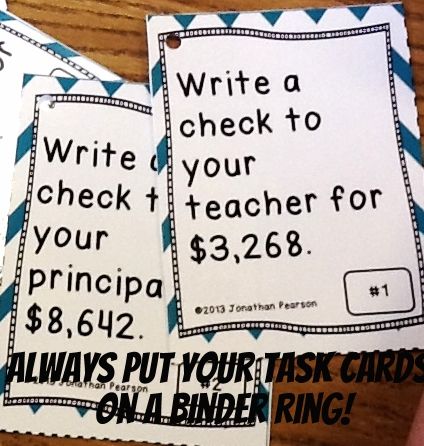
Always put your task cards on a
binder ring!
I shared the other day about introducing my new third grade students to math centers. One of the centers that I introduced was "Check Writing," which has the students writing numbers in standard and written form on a specially designed check that I created just for the center. I made three sets of the task cards on cardstock, cut them out, and laminated them. I carefully put them into three groups (there are 24 task cards in each group) and put the task cards into envelopes for the students to pick up when they chose that center.

Everything was going swimmingly with my centers. At least until clean up time came. Maybe it is just a third grade thing, but clean up seems to be a disaster every day. Children who were behaving wonderfully seem to lose their minds when it comes time to put things away. This is especially true for task cards that come out of envelopes.

Now maybe I wasn't specific when I gave the instructions, but I'm pretty sure that I said to make sure that all cards that come out of envelopes go back into the same envelopes. This, of course, was not the case. When I started to clean up from the day, I noticed that one envelope of cards was very anemic while another envelope looked as if it had just enjoyed a seven course meal. Instead of returning the cards to the correct envelope, the students just shoved the cards into whatever envelope they could find. I even found some of my Check Writing cards in envelopes with Pirates vs. Ninjas, another place value center. I had to sort all of the cards (again!) to make sure they were all there.

So I wised up. I probably should have done this to begin with, but I invested in some binder rings. I put all of the cards on rings. It was beautiful. And the best part? No cards got misplaced! I am a genius. Now, I just need to remember to do it again in the future.


Monday, September 16, 2013

Introducing Math Centers

One of the things that I am big on in teaching math is math centers. My team and I work hard to create some exciting centers for the students. I want them to be practicing the skills that we are teaching, but to do so in such a way that they don't realize they are learning. If the rest of the year continues the way our first day went, I think I might be successful at that.

The first centers I introduced were place value oriented. We have been focusing on the skills of writing numbers (in standard, word, and expanded form), comparing numbers, and rounding numbers. With that in mind, I created a number of centers to help reinforce those skills.


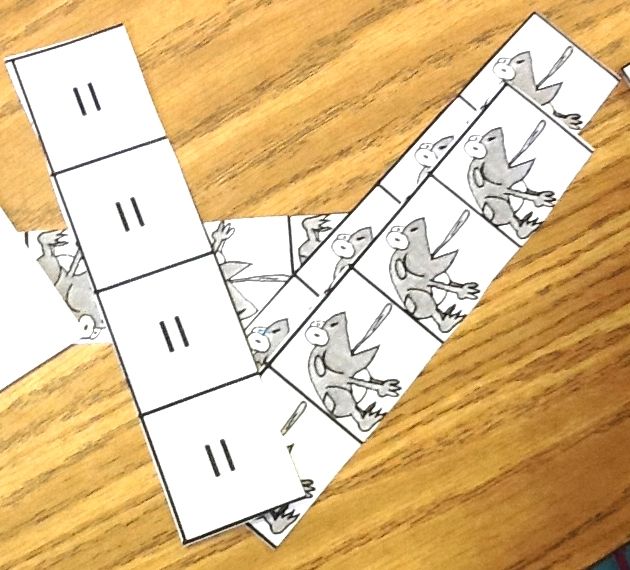
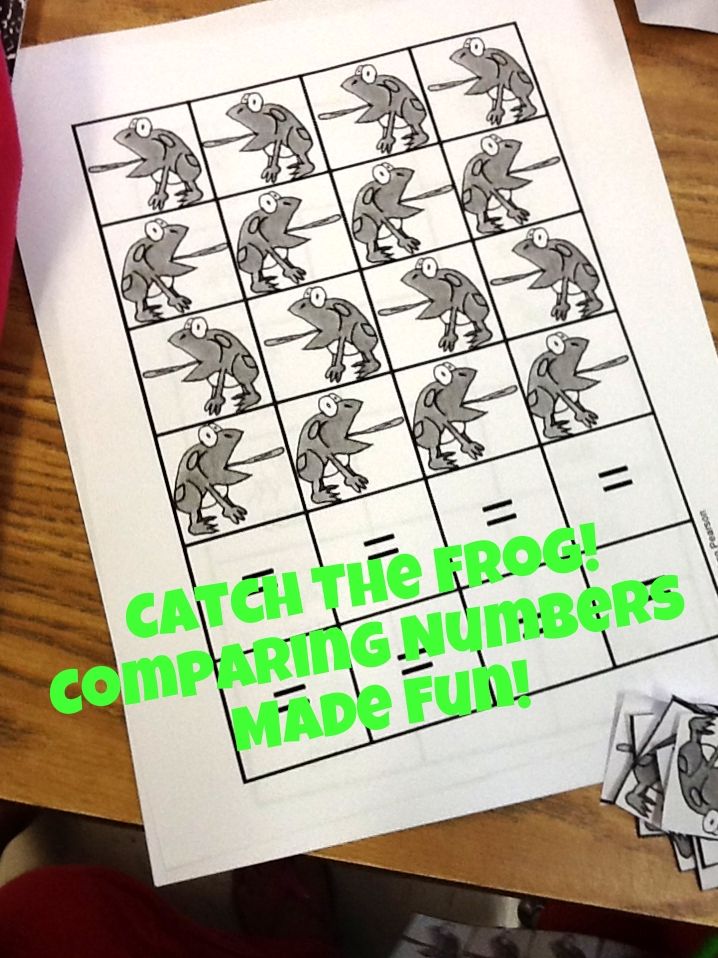
The first center I introduced to the students was something I call "Catch The Fly!" This activity allows the students to compare numbers using the symbols for greater than, less than, or equal to, but does it in a way that encourages a bit of fun. Instead of using the regular (boring) symbols, the center gives students special frog symbols to use. Each of the numbers being compared has a fly over it, so the frog is trying to eat the bigger of the two flies. The students were very excited about this one and were meticulously cutting out their frogs.  The only thing that I would change about this center is the fact that the frogs they are using are black and white.  The actual file has them in color, but that is a lot of color ink to use when making enough sheets for the whole class to use.


Another center that I rolled out for my students today made them feel really grown-up.  This center is called "Check Writing."  The students get to use the skills of writing numbers in standard form and written form to fill out a check for an amount that is listed on the task card they have chosen.  They were so excited to be writing "real" checks, especially when the task card told them to write a check to their teacher.  I did have to correct one student who wrote "My Mom" when the task card instructed her to write a check to her mother.  It did make me laugh.  This center has the students writing four separate checks and the hardest part for them so far was knowing what the date was.  We had to stop and have a mini-lesson on how to use this great new invention known as the calendar.  I just wish the checks they were writing to me were real.

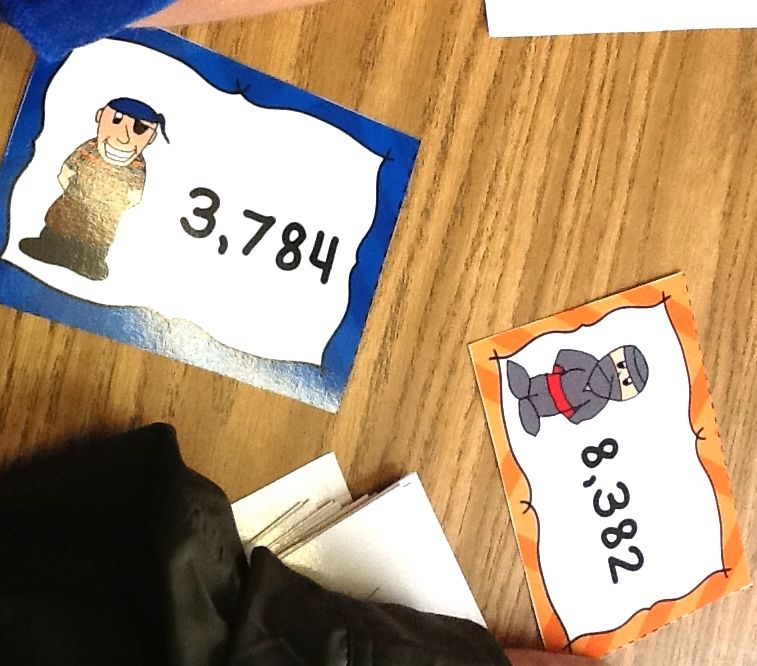
One last center that I want to share with you is the one the students were most excited about.  This center, called "Pirates vs. Ninjas!" has the students comparing numbers, but they are doing it through an exciting card game.  Each student is given a deck of cards and an activity sheet.  With a partner, the student will flip over his card while his partner does the same.  They compare numbers, write down both numbers, and then determine who the winner is.  After 10 rounds, the player with the most wins is the champion.  My students loved this activity because there was a competition aspect to it.  All of the students wanted to play, but as I only made two sets of the cards, this one was in high demand during both math groups.


Each week, I try to have at least nine centers for the the students to choose from.  All of the choices are self-selected, but the students have to complete a certain number of centers before the end of the week.  This is often their favorite part of math time.  I really enjoy seeing them get so excited about applying their learning (even if they don't always realize they are doing it.)

If you are interested in learning more about the centers I shared above, or would like to purchase copies of your own, Catch the Fly!, Pirates vs. Ninjas, and Check Writing are all available for purchase at my TeachersPayTeachers store.  If you make use of them, I would love for you to share how your students responded to the activities.

What centers do your students love the most?